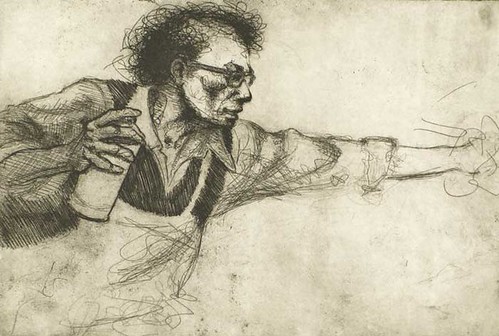
Spray Paint

Cello Players
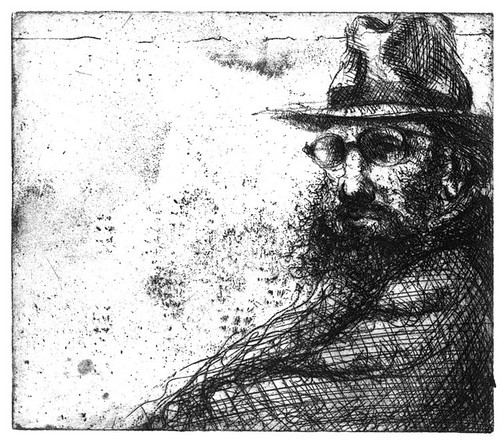
Bud Waldo
All etchings above
(posted here with permission) © Bruce Waldman,
a lecturer at the School of Visual Arts in New York.
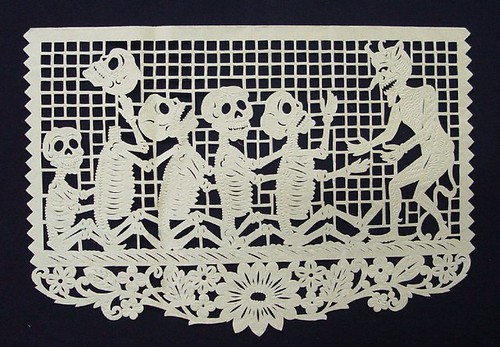 Día de los Muertos
 (Day of the Dead) papercut motif produced in the 1980s by Maurilio Rojas from San Salvador Huixcolotla in Mexico. The image comes from
the British Museum and the chisel/paper technique is referred to as
Papel Picado.
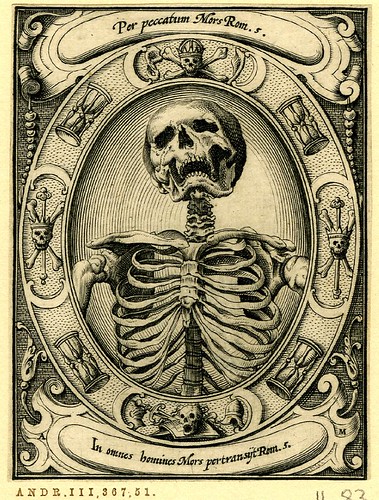
"A skeleton; half-length; set in an oval frame with hourglasses and skulls and bones"
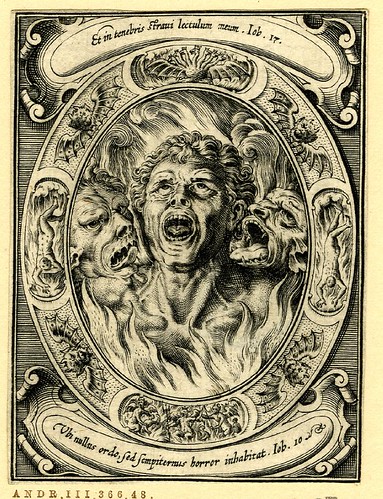
"The Damned; three bust-length male figures surrounded by
flames; set in an oval frame with bats, devils and seven-headed beasts"
From a series of six engravings of
memento mori* by the German artist Alexander Mair, 1605.
(these are definitely the best of the series) [
British Museum]
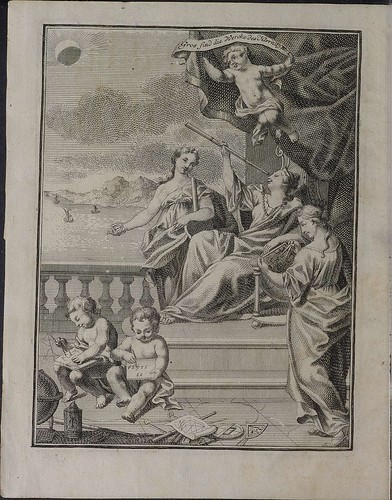
Frontispiece featuring muses
(?) from
'Astronomisches Handbuch' by Johann Rost
*, 1718 from
HAB.
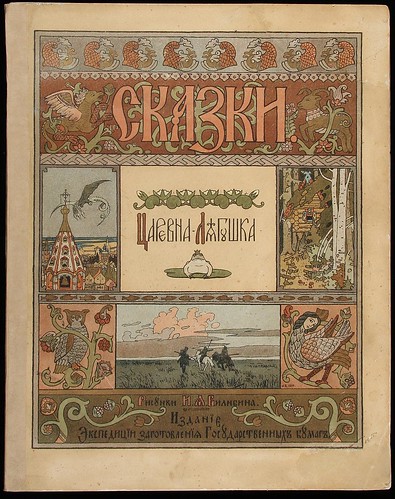
This is a cover from
'Carebna Babushucka' 'Carevna Lyagushka' (Queen-Frog, Fairy Tales) by
Bilibiu (illustrated by HA Ghangnai) Ivan Bilibin, 1901 (the above image came from one of the catalogues at
PBA Galleries)
[see comments at the end of this post]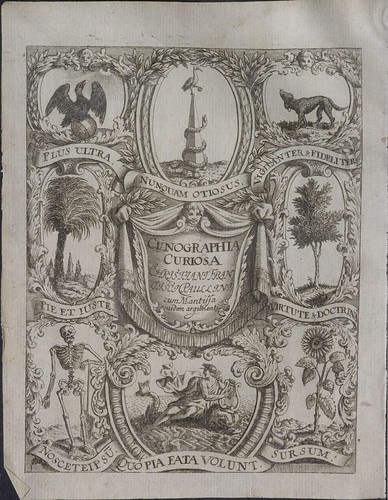
Frontispiece from
'Cynographia Curiosa Seu Canis Descriptio' by Christian Franz Paullini - 1685 (
HAB), a zoological treatise as
the reliable Philological Museum advises (a great resource for finding online neo-latin texts).
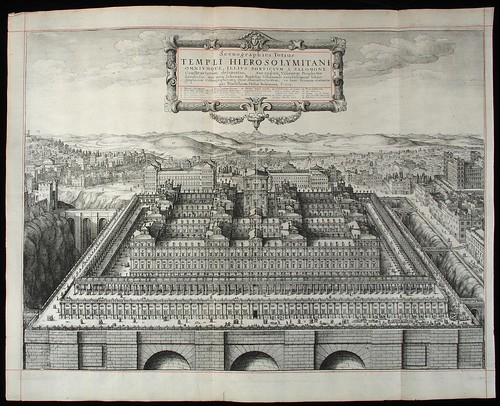
Solomon's Temple from a 1660 version of the King James Bible
(published by John Field) (from
PBA Galleries)
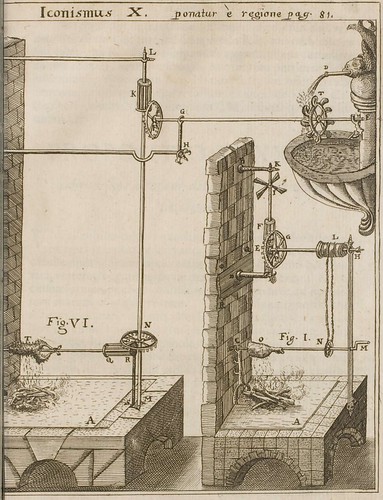
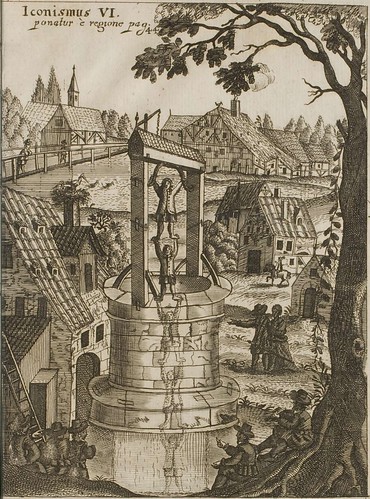
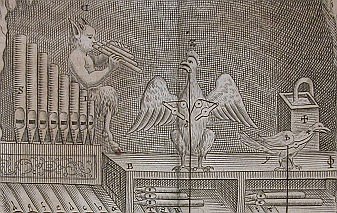
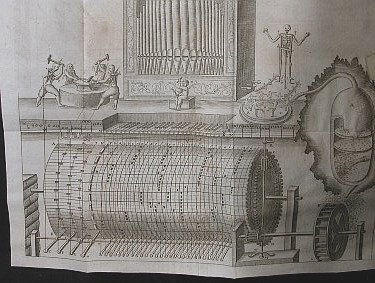
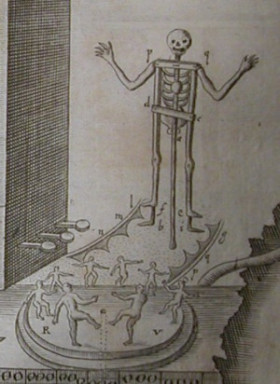
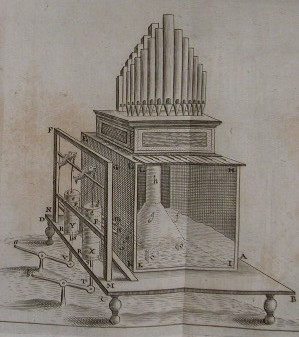
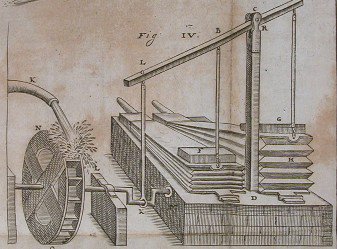
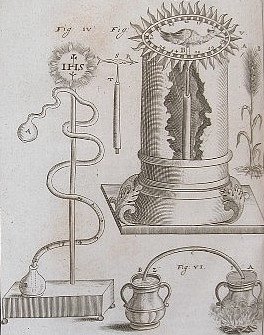
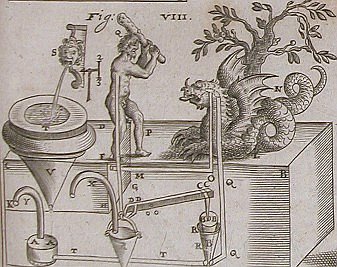
Gaspar Schott
(previously) was an assistant to Athanasius Kircher. All of his works are fairly eccentric and most are derivatives or additives to Kircher's own large and eccentric body of work. The above two images were the more interesting examples from his 1667 book,
'Ioco-Seriorum Naturae Et Artis, Sive Magiae Naturalis Centuriae Tres', from
HAB. The work is
said to describe more then three hundred physical, chemical, alchemical and magical experiments and tricks.
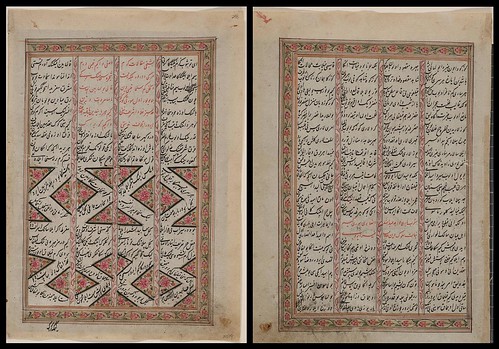
'Khamsah of Nizami' - a 19th century copy of a 12th century Persian poem. We are told:
"Persian poetry, written in calligraphy on handmade paper. One of Persia's most famous poets, the twelfth century Nizam-uddin Abu Mahommed Ilyas bin Yusuf lived most of his life in Ganja, in what now is Azerbaijan. Nizami is best remembered for his Khamsah, or Quintet, which also is known as Panj Ganj or Five Treasures. Nizami wrote the five long narrative poems in couplets, using different meters for each. Three of the poems are romances and celebrated as the most important Persian language examples of the genre. This fragment of the Khamsah of Nizami was done in calligraphy in the mid-nineteenth century."
These pages come from the
'Illuminating the Manuscript Leaves' exhibition site at the University of Louisville, Kentucky.
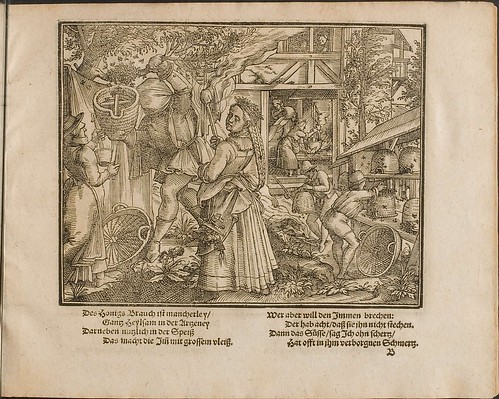
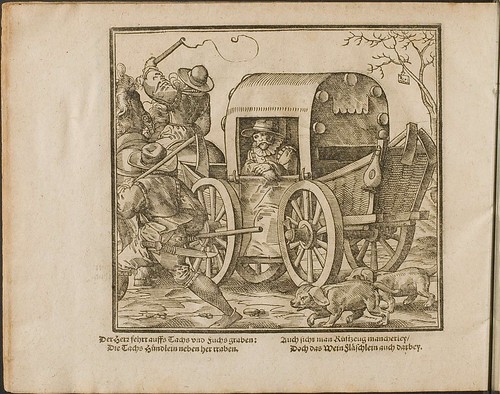
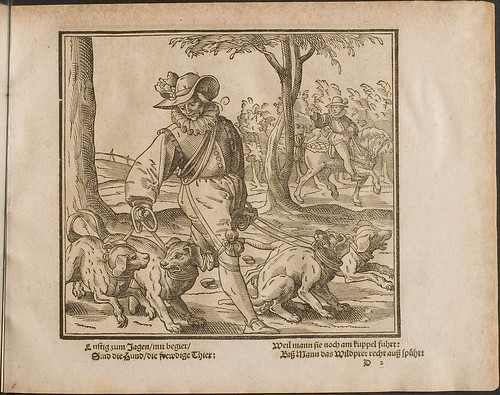
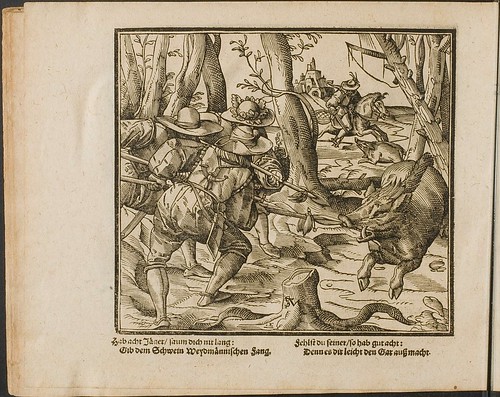
A hunting (and less so, agriculture) book by the Swiss pair, Tobias Stimmer and Christoph Maurer, called:
'Künstliche Wolgerissene Figuren und Abbildunge Etlicher Jagdbahren Thieren' from 1605 (at
HAB). There are about forty woodcuts; interesting to me for all the incidental details in the scenes.

"St Michael; the archangel standing on top of a devil,
piercing him with a lance; the demon holds onto a shield"
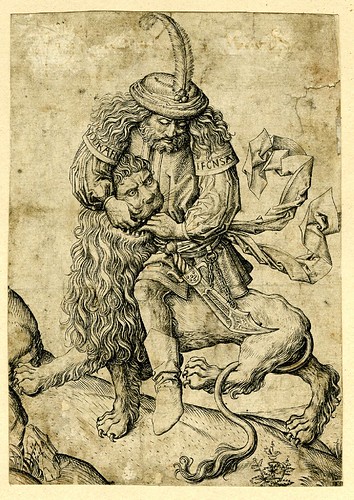
Samson rending the lion
Prints from between 1475 and 1500 by the Dutch
artist known as Monogrammist FVB [
British Museum].
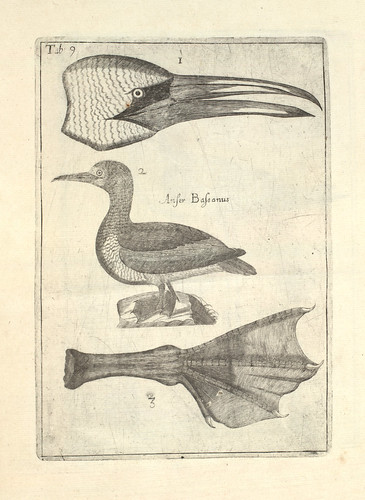
A gannet, "a bird that was of enduring interest to Scots because its association with the Bass Rock gave it its Latin name, given here as Anser Bassensis, and in its modern form, Sula Bassana"
This illustration of a gannet comes from the 1684 publication:
'Scotia Illustrata' by Robert Sibbald. I did a very cursory search around (some weeks ago) and was disappointed only to find a couple of other poor quality animal drawings from this intriguing work. We are told:
"Sir Robert Sibbald (1641-1722) was appointed Geographer Royal to King Charles II. His description of Scotland begins with the peoples, geography and climate of the different regions, followed by an account of diet, diseases and the medicinal uses of Scotland's natural products. He then lists all known flora, fauna and minerals. His plan, outlined in his 1683 'Account of the Scottish Atlas, or the Description of Scotland', was to produce a two-volume work: 'Scotia Antiqua' and 'Scotia Moderna'. In the event, this Atlas was never completed. Only the natural history, 'Scotia Illustrata', was ever published. It is nevertheless a key work in establishing the absolute value of objective, empirical information in all fields."
I found the plate somewhere in the
Special Collections, Edinburgh University Library.
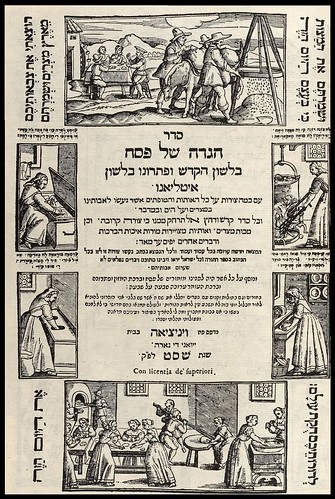
My notes say: "Seder Hagadah shel Pesah, Venetsiah - 1609 -
Jewish Theological Seminary". Again, I found the various background details in the woodcuts that make up this titlepage intriguing.
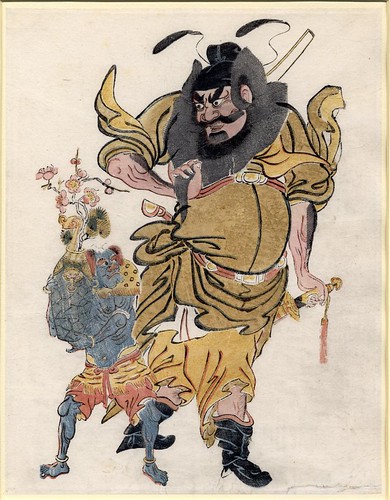
Zhong Kui and a demon with a vase of plum blossom

Zhong Kui assaulting a demon with an axe

Zhong Kui drawing his sword, attended by a
demon carrying magic jewels on a tray on his head
These 17th century coloured woodblock prints come from the
British Museum. The biography of the mythologoical Chinese figure,
Zhong kui:
"God of Literature, vanquisher of demons. Zhong Kui excelled in the metropolitan examinations and was due to receive honours from the emperor. The emperor found Zhong Kui's ugly face repulsive and refused to give him the honours. Zhong Kui threw himself into the sea, but was saved by the ao-monster, which carried him to the surface on its back. Zhong Kui has come to be associated with the Kui-constellation, often regarded as his heavenly palace. His fame came after the Emperor Xuanzong of the Tang dynasty, during an illness, saw Zhong Kui in a dream, where he dispatched two demons tormenting the emperor and Yang Guifei. Upon awaking, the emperor was restored to health."
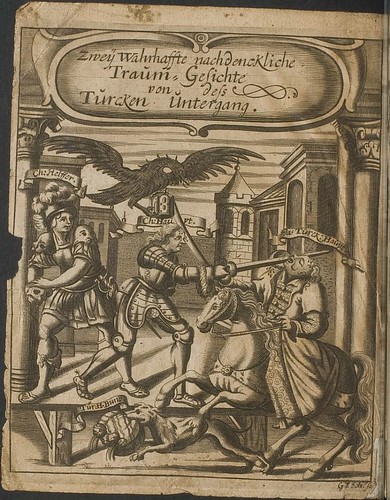 'Zwey Nachdänckliche Traum-Gesichte'
 1684 by Georg Speer, a travel book I believe. It comes from somewhere in the recesses of
HAB.

French gothic ornament
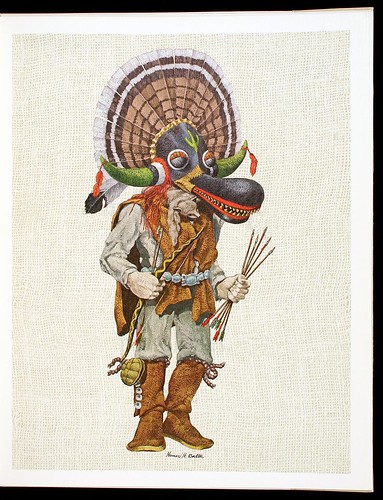
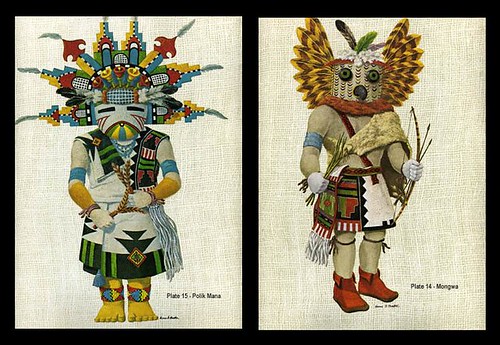
These illustrations are presumably © the estate of Homer H Boelter.
In 1969 Boelter published an album of lithographs of Hopi Indians -
'Portfolio of Hopi Kachinas' - limited to one thousand copies. The first illustration above comes from
PBA galleries. The paired image and the balance of the sixteen plates in the series - and background - can be found at
Native American Links.

Bouquinosphère 3 was some sort of conference. I just liked the sentiment expressed in the picture which was found
here a couple of months ago. I don't know if it's derivative and I spent way too much time unsuccessfully trying to work out its origin when I first found it.
No, I couldn't find a larger version. Click on the image for larger original version (Australia Post advertisement) [Thanks Sveta!].
Other things...
For those that read via rss and don't visit the site, I've added a feed from
my own del.icio.us bookmarks to the sidebar. It naturally gravitates towards the book, illustration, exhibition, library, gallery, manuscript kind of material, plus other bits and pieces. It also tends to be the place I accumulate links that may or may not end up on BibliOdyssey.
Some blogs:
- Cartophilia - a lover of maps.
- Notes for Bibliophiles - "The official blog of the Special Collections department of the Providence Public Library".
- bookn3rd - "Book History and diversions therefrom."
- Grain Edit - "Inspiration from vintage kids + rare graphic design books"
- Publick Occurrences - "blog of historical and political punditry by the inimitable Common-place columnist and former History News Network blogger Jeffrey L. Pasley."
- Library Preservation - Kevin Driedger on rare book conservation/preservation.
- Le territoire des sens - art . architecture . design . nature . science