"Thus have I been wishing to reveal to you in this treatise, as far as may be lawful to me, the Stone of the Ancients, that you, too, might possess the knowledge of this highest of earthly treasures for your health and comfort in this valley of sorrow.
I write about it, not for my own good, but for that of posterity, and though my words be few and simple, that which they import is of immeasurable magnitude. Ponder them well, that you also may find the Rock which is the foundation Stone of truth, the temporal blessing, and the eternal reward." [B.V.]
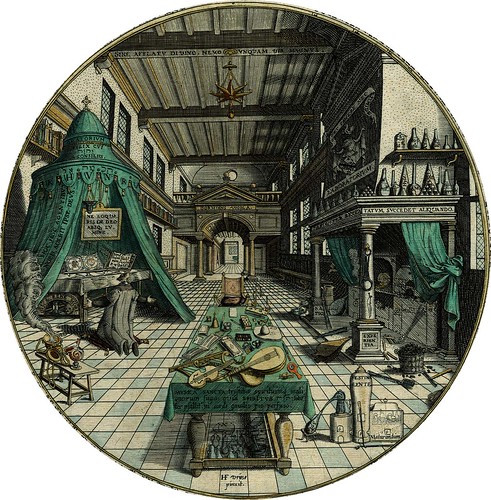
Alchemist's Laboratory IN:
'Amphitheatrum Sapientiae Aeternae'
by Heinrich Khunrath, 1595.
"[A]n alchemical classic, the best known of Heinrich Khunrath's works. The work is infused with a strange combination of Christianity and magic, illustrated with elaborate, hand-colored, engraved plates heightened with gold and silver. The tension between spirituality and experiment, and the rich symbolism of Khunrath's writings and their engravings brought condemnation of the book by the Sorbonne in 1625, and now attracts attention from scholars." [source]
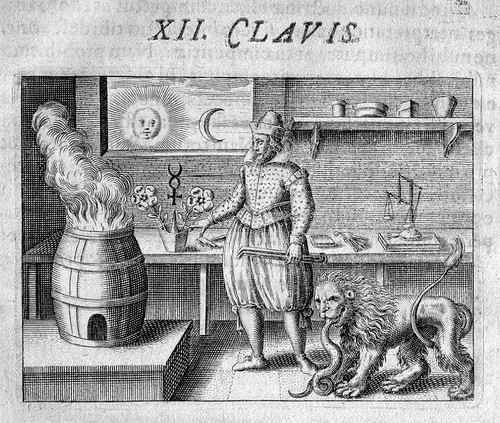
An emblem that came to be known as the
'Twelfth Key of Basil Valentine' first appeared in a book from 1599,
'Ein kurtz summarischer Tractat' (Basil Valentine). The version above ('clavis' = key) appeared in Michael Maier's
'Tripus Aureus', published by Theodore de Bry in 1622.
In vague and basic terms: as the lion transforms the serpent into its own flesh when he devours it, so the philosopher's stone has the power to transmute or transform all imperfect metals into gold; but pure gold is required as one of the ingredients.
Ahh, but how does one create the philosopher's stone?
That is the eternal question..
 'Distillatio'
 by Jan van der Straet, originally published in his
'Nova Reperta' series from the 1580s, as reviewed previously in
Renaissance Discoveries and Inventions.
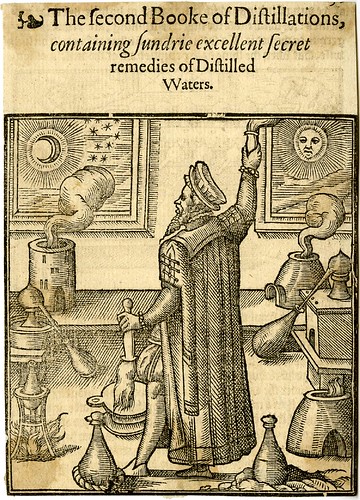
'The second Booke of Distillations, containing Sundrie
excellent Secret remedies of Distilled Waters'
Anonymous woodcut illustration of alchemist in his laboratory IN:
'The Practise of the New and Old Phisicke' by Conrad Gesner, 1599. [
source]
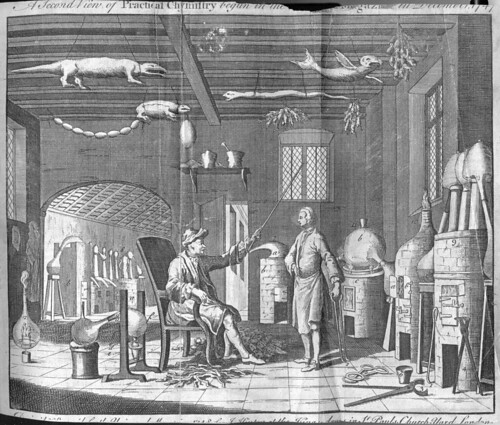
'A Second View of Practical Chymistry' IN: 'The Universal Magazine' [vol. 2], 1748.
Key to the figures (click picture for larger version):
"1. An iron hook to clear the grate with.
2,3,4, several sorts of tongs.
5, Iron rings to break glasses with.
6, A black-lead crucible.
7, A furnace for distilling hartshorn in quantity: a is the earthen head: b the body of the furnace, containing an iron pot.
8, A digesting furnace: a is a balneum at the end of the furnace: b, the sand bath. 9, The Balneum Mariae.
10, a melting furnace: a,b, are two small doors to the fire-place to be opened occasionally, when it is necessary only to inspect the matter acted on by the fire, or to add fuel: c a large door to be opened, when a crucible is to be set in or taken out of the furnace.
11, A small furnace, in which flowers of sulphur are sublimed in small quantities: a,a, are two receivers: b is an earthen or iron head: c is the vessel which contains the sulphur in the furnace.
12, a plain glass bell for making spirit of sulphur: a is a vessel containing burning sulphur, with a receiver under it.
13, a more commodious apparatus for making spirit of sulphur: a is a large retort with a hole in its bottom, and running into a tubulated receiver, with the spout upwards: e a glass mortar: d a concave glass plate, with a hole in the middle: c a gallipot inverted over the perforation in d. b A crucible containing burning sulphur."
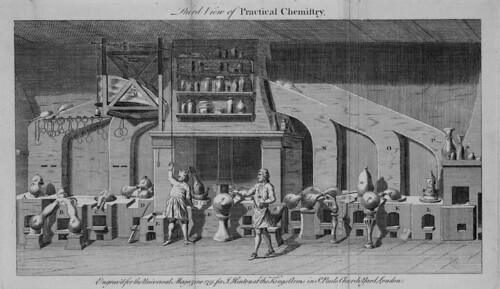
'Third View of Practical Chemistry'
IN: 'The Universal Magazine' [vol. 8], 1751.
Key to the figures (click picture for larger version):
"A, a furnace for distilling in balneum mariae.
B, a furnace for making spirit of hartshorn, &c. in great quantities, e, its head, and b,b, two receivers.
C, a sand furnace; d a retort placed in it.
D, another sand-furnace, having a copper distilling body placed in it, to which it is fitted (d) a glass head, and (e) a receiver.
E, a small open furnace for divers uses, as boiling syrups, evaporating liquids, &c.
F, a wind-furnace, blown by the bellows, M, f a cucurbit in a copper vessel with sand, placed over the furnace.
G, a sand-heat, with a retort and a receiver.
H, H, two sand-heats, in each of which is placed a retort k, m, for distilling volatile spirits, one of which has a single receiver l, and a double one i, k.
I, a cold still; n and o the receiver.
K, a sand-heat, in which a retort q, having a large receiver p fitted to it for making sal volatile.
L, a digesting furnace, having a circulatory vessel r, s, placed in it for extracting tinctures, &c.
N, O, P, three chimnies, which, after uniting, join the main chimney of the laboratory."
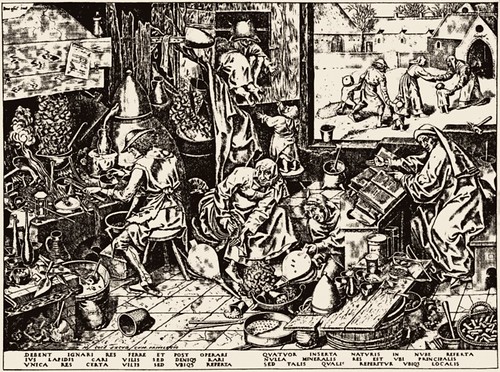
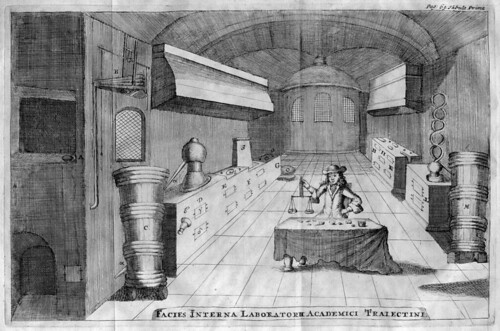
'Facies Interna Laboratorium Academici Traiectini'
(Interior View of a Laboratory at the University of Utrecht)
IN: 'Pyrosophia, Succinte atque Breviter
Iatro-Chemiam, rem Metallicam et
Chrysopoeiam Pervestigans' by
Johann Conrad Barchusen, 1698.
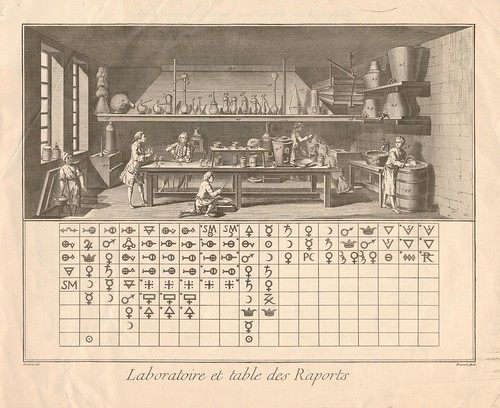
'Laboratoire et Table des Raports'
Artist: Louis-Jacques Goussier Engraver: Benoît Louis Prévost
IN:
'Recueil de Planches, sur les Sciences, les Arts Libéraux, et les Arts Méchaniques', 1772.
{an earlier version appeared in Diderot's
'L'Encyclopédie', 1751-1765}

'L'Alchimiste'
Original painting by David Teniers (before 1690).
This version engraved by Jacques-Louis Pérée, 1769.
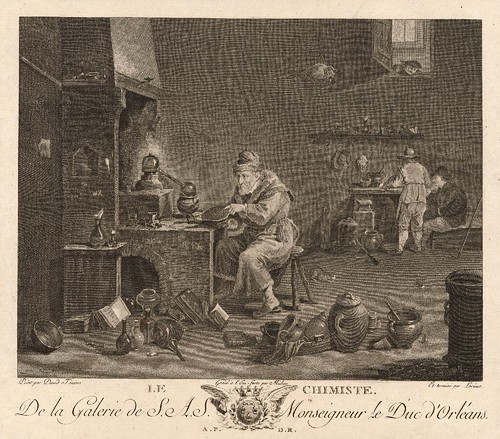
'Le Chimiste
De la Galerie de S.A.S. Monseigneur le Duc d'Orléans'
Original painting by David Teniers (before 1690). This version engraved by FB Lorieux sometime in the 1700s. "Alembic and crucible sit on furnace in center of image; miscellaneous apparatus in foreground."
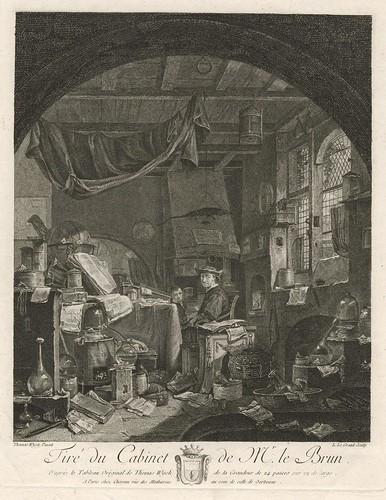
'Tiré du Cabinet de Mr. le Brun'
Original painting by Thomas Wyck. This version engraved
by Louis-Claude Le Grand sometime in the 1700s.

'Le Docteur Alchimiste'
Original painting by David Teniers (before 1690).
This version engraved by Jacques Nicolas Tardieu sometime in the 1700s.
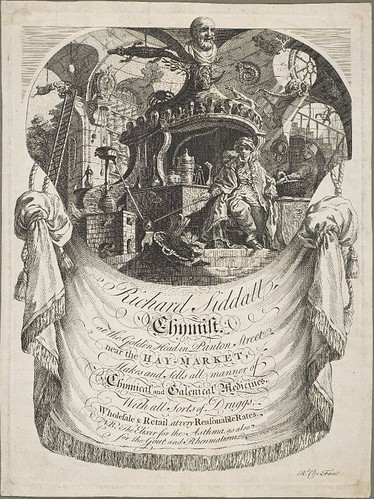
"Trade card of Richard Siddall, chemist at the Golden Head in Panton Street, near the Haymarket, London; a scene of an apothecary's laboratory above, with an advertisement lettered on a fringed curtain below; the chemist seated next to a still and upsetting a log-basket; immediately behind him, an elaborate covered stove with various instruments, surmounted by a bust of Galen; to right, a woman with another basket, looking over her left shoulder; hanging from the ceiling and around the walls, various dried and stuffed preparations including a crocodile, an elephant head, a rhinoceros head, a crab, coral, fish and shells; in the background to left, shelves with labelled jars and a clock."
The card, etched/engraved by Robert Clee in about the 1750s "is based on a painting entitled 'La Pharmacie', one of a series by Jacques de Lajoue made for the Duc de Picquigny in 1735 and known in London from a print of 1738 by Charles Nicolas Cochin." [source]
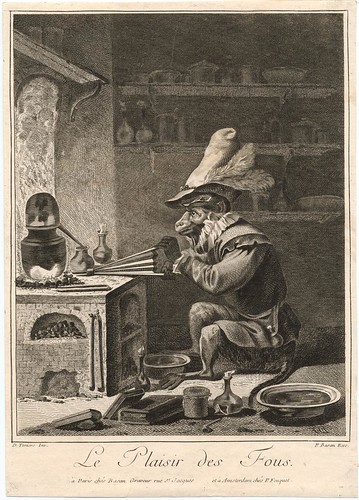
'Le Plaisir des Fous'
(The pleasure of fools)
Original painting by David Teniers (before 1690). This version engraved by Pierre-François Basan sometime in the 1700s. This satirical view of an alchemist shows that not all illustrations were meant to be taken too seriously.
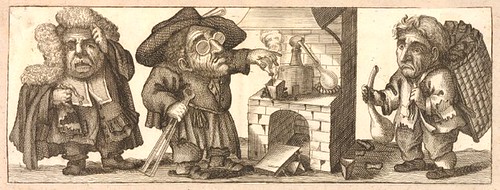
'Raccolta di Diverse Caricature'
(Collection of diverse caricatures)
Print made by Arnold van Westerhout, 1687.
"The Alchemist. Three deformed figures, whole length standing, the middle one wearing glasses and a large hat, heating up liquids in chemical bottles over a stove, the right figure carrying a basket with charcoal."
"This is one from a series of eleven plates (plus title), first sold from the artist's bottega in Rome near San Ignazio in 1687; later published by Monaldini in 1765. Ten of the plates show three or four caricatural figures each."
The subject is known as a 'Callot figure' -- "The term refers to a particular type of diminutive human figure which appears in the 18thC in the fine and decorative arts. Although described as Callot figures, they differ substantially from the work of Jacques Callot." [source]
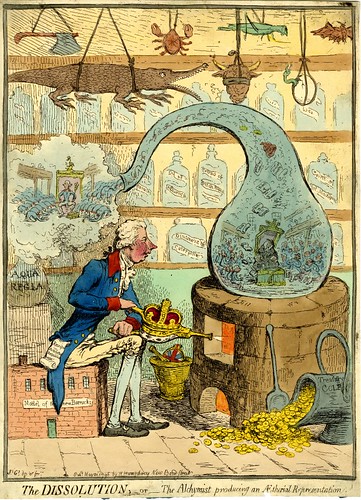
'The Dissolution, or The Alchymist producing an Aetherial Representation'
Hand-coloured etching made by James Gillray, 1796, in reference
to the dissolution of Parliament announced on 19 May.
"Pitt as an alchemist, but dressed as usual, sits in his laboratory blowing a furnace with bellows formed of a royal crown. The furnace heats a large glass retort in which the House of Commons is being dissolved: the galleries are collapsing, the Speaker's chair is breaking, he and the clerks are asleep, the broken mace drops from the table, the books fly into the air and ascend with documents, &c, into the curving neck of the retort: 'Coke', 'Acts', 'Statutes', 'Rights of Parliament', 'Magna Charta', 'Bill of Rights', a cap of 'Libertas', the scales of Justice are flying upwards. [..]
A stream of vapour issues from the mouth of the retort containing tiny grovelling figures of abject members who fill both sides of another House of Commons above and behind the alchemist's head, and prostrate themselves before a miniature Pitt, who sits on a throne which replaces the Speaker's chair, and is inscribed 'Perpetual Dictator' [..]
From the roof hang emblems of nefarious wizardry: a crocodile, a headsman's axe, a scorpion, a bull's head, a locust, an asp issuing from an egg, a bat. On the wall are three rows of large jars, some with inscriptions: 'Ointment of Caterpillars', '[Univer]sal Panacea', 'Oil of Influence', 'Extract of British Blood', 'Spirit of Sal: Machiavel.'" {I left a lot out of the description, believe me} [source]

'La Chimie'
Alchemy laboratory, with alembic
* at centre, and, at right, four putti
* gathered around a crucible; at left, a putto carrying coal in a basket. Engraved by Bernard Picart IN Bernard de Fontenelle's
'Oeuvres Diverses', 1729. [
source]

'Doctor Panurgus', engraving by Martin Droeshout ~1620s.
"Satirical broadside on folly: the interior of an apothecary's shop, with the doctor purging with drugs a countryman seated on a close-stool who defecates his animals of various sorts; at the right a fashionable young man with his head in an oven has follies cooked out of him which emerge in a cloud at the top; they include cards, backgammon, tennis, fencing, playing music, extravagant clothes; in the centre a well-dressed man and woman (holding a squirrel on a lead) wait to be treated. 1620s" [commentary source]
The very complex background to this illustration (
posted previously) was discussed at the source site for the picture,
British Printed Images to 1700, as part of their Print of the Month series.
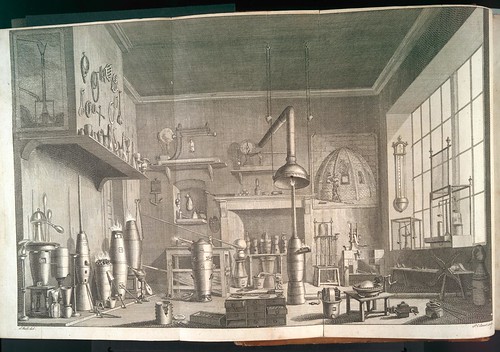
'Laboratory for metallurgy and the industrial arts'
Original painting by Samuel Wale. This version engraved by Pierre-Charles Canot, 1765. The illustration appeared IN:
'Commercium Philosophico-Technicum' (The Philosophical Commerce of Arts) by William Lewis.
"Eight furnaces in various locations; two balances on windowsill. This laboratory may have been intended for metallurgical work, glassmaking, and other chemical and industrial experiments."
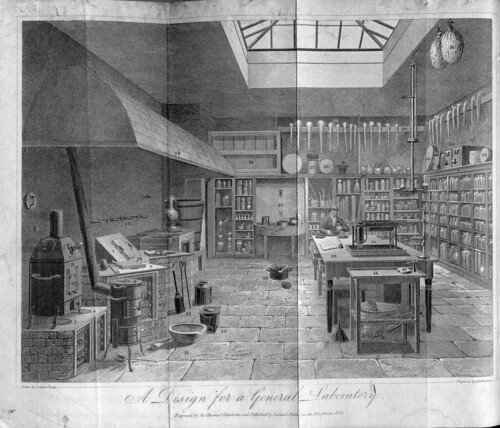
'A Design for a General Laboratory'
Artist: Cornelius Varley; Engraver: AW Warren, 1822.
This illustration formed the frontispiece of the 10th Ed. of
'The Chemical Catechism' by Samuel Parkes (about: 1860s/1870s).