"[W]e are inclined to believe them to be produced by an evolution of the planet, just as on the Earth we have the English Channel and the Channel of Mozambique. [..]
Their singular aspect, and their being drawn with absolute geometrical precision, as if they were the work of rule or compass, has led some to see in them the work of intelligent beings."
[Giovanni Schiaparelli]
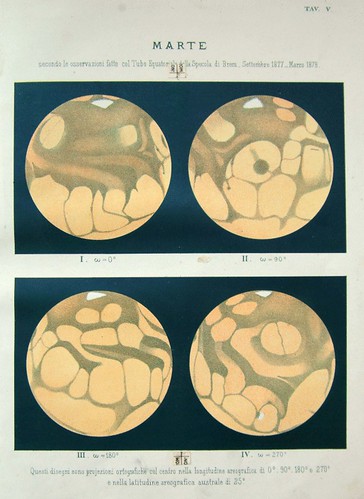
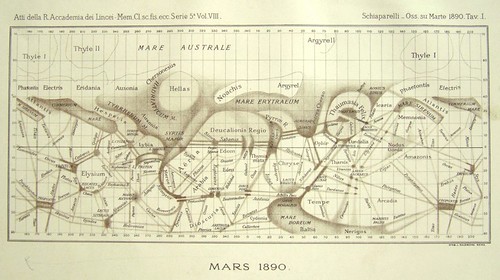
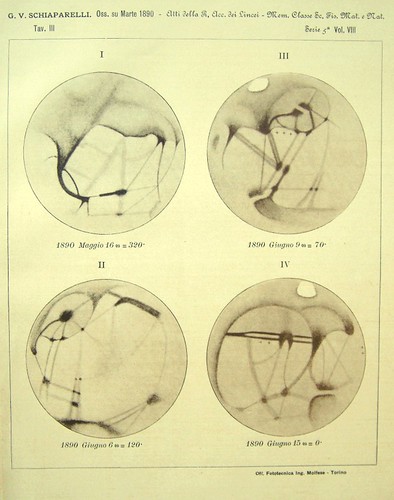
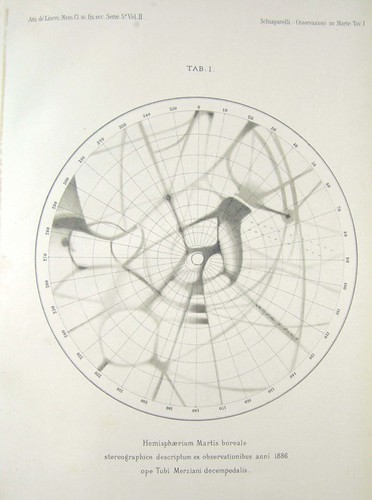
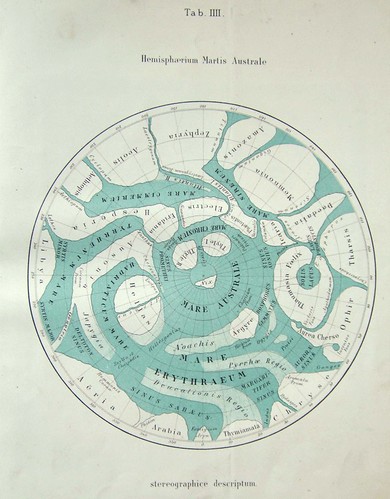
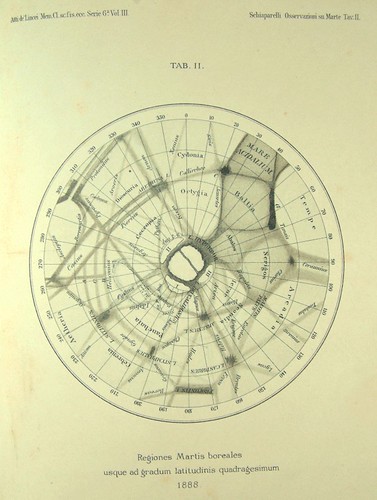

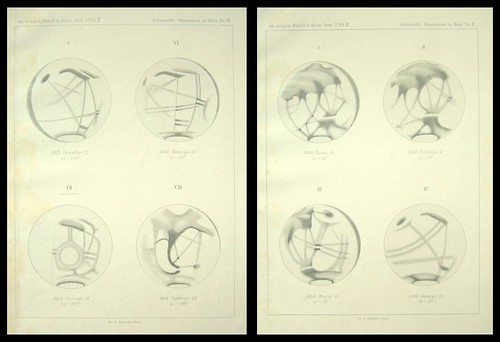
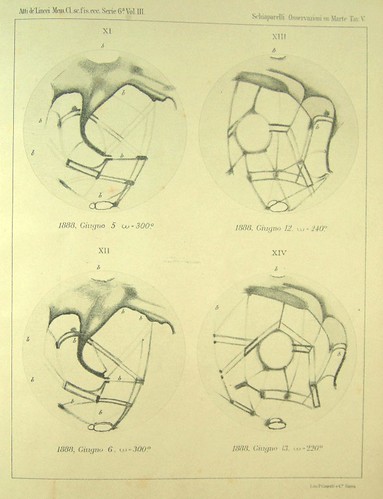
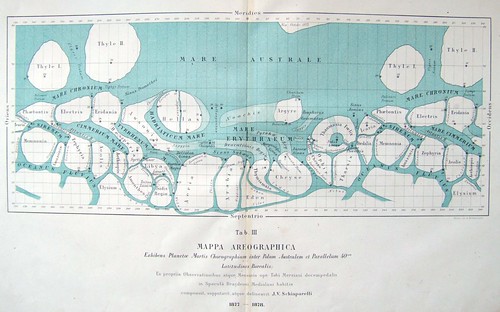
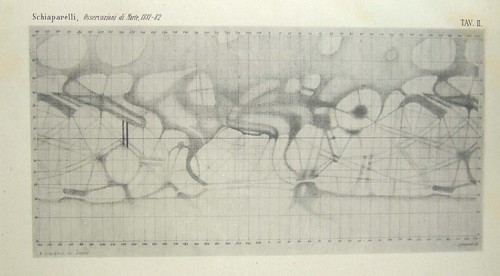
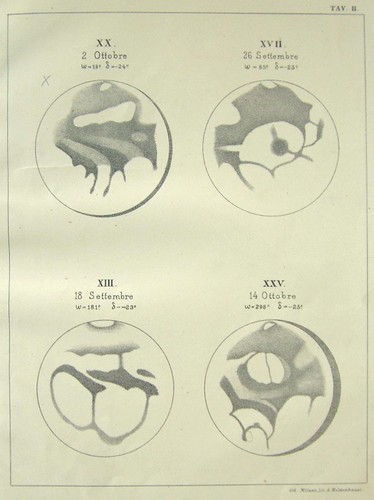
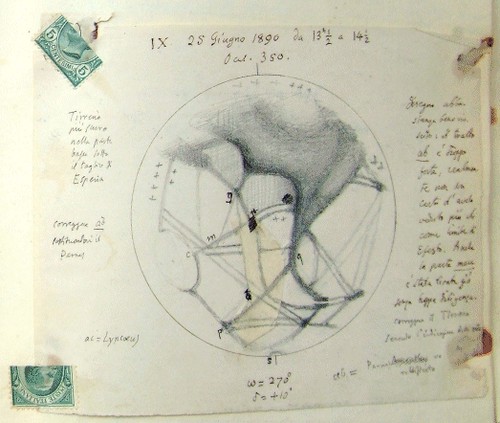

If we skip past some of the early contributors to our knowledge about the planet Mars -- Aristotle, Ptolemy, Copernicus, Galileo, Brahe, Kepler, Maraldi, Huygens, Herschel, Schroeter and doubtless other astronomers, all sharing the common handicap of relatively poor visual equipment -- we arrive in the second half of the nineteenth century, when the telescope's quality of resolution had advanced sufficiently, allowing for observation (and therefore mapping) of the Martian landscape.
Chief among the early cartograhpers of Mars was Giovanni Schiaparelli (1835-1910), an Italian astronomer who worked at Brera Observatory in Milan for more than thirty years. In the late 1870s he produced an audaciously detailed map of Mars for which he had devised a nomenclature system to identify the newly discovered features. His system drew upon his knowledge of classical mythology, Greek and the Bible and thereby anointed the planet with "a set of romantic and wistfully evocative names".
The myopic and colour blind Schiaparelli (neither of which, in all seriousness, hampered his renown as a meticulously observant astronomer) included in his map -- which he continued to augment all through the 1880s, and which served as the cartographic authority on the Martian landscape in planetary astronomy for two decades -- linear features that he saw criss-crossing the surface of Mars, which he referred to as 'canali'. This Italian word translates to English as either 'channels' or 'canals', and although Schiaparelli was implying the more naturalistic descriptor, 'channels', somehow 'canals' became the accepted terminology.
Whether or not there was any relationship between the construction of the Suez Canal at about the same time -- a decidedly artificial project -- and the way in which these martian canals added fuel to the romantic notion of there being intelligent lifeforms on Mars, is a matter for speculation. Nevertheless, and without going much further into the details, Schiaparelli inadvertently generated a most newsworthy phenomenon. Writings by the emphatic protagonist for the life on Mars idea, Percival Lowell (last picture above), were sufficiently noteworthy at the time to (apparently) provide inspiration for one of HG Wells' science fiction books.
Schiaparelli's (in)famous 'canali' turned out to be a kind of optical illusion caused by interactions between light, dust clouds that form in the martian atmosphere, the orbital location and background interference from the planet's surface itself. If a sketch is made of something that wasn't really there but you believed it to be there at the time, can you call the result abstract art I wonder? I guess so.
- The Brera Observatory website, 'Le Mani su Marte', presents pictures of Schiaparelli's diaries as well as lithographs of his maps and sketches: the origin of the majority of the above images.
- I *think* the illustrations are taken from an 1890s publication by Schiaparelli titled 'La Vita Sul Pianeta Marte' - this is the text in Italian at Project Gutenberg. [correction: this is Schiaparelli's original 1895 publication but not the source of the images. See Paolo's comment below (he ought to know).]
- The best background to all of this is the 1996 book by William Sheehan called 'The Planet Mars: A History of Observation and Discovery' which has been posted online by the University of Arizona Press. It's definitely worthwhile reading at least the first few chapters.
- Biography of Schiaparelli at the Internet Encyclopedia of Science.
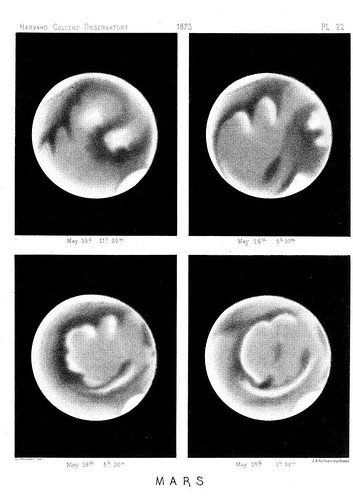
- The second last image above (from 1873) is by Étienne Trouvelot (remember Trouvelot??) from the Annals of the Astronomical Observatory of Harvard College.
- The two wikimedia images above come from the Mars wikipedia article.









13 comments :
I don't know that I've seen any research on maps of mars. This would be really fascinating, especially in connection with other maps of "unknown" (or unvisited) lands. Great post.
None of the images comes from Schiaparelli's original 1895 paper "La vita sul pianeta Marte". Some of them appear as illustrations of a contemporary book by the same title, which reprints some science popularization papers by Schiaparelli including that one: "La vita sul pianeta Marte" by Pasquale Tucci, Agnese Mandrino and Antonella Testa, MIMESIS, 1998.
This prompts thoughts of the possibility of future interesting maps of Saturn's moons (I think it was Saturn's) which are now believed to have some sort of water under the surface.
It's my understanding that Giovanni Schiaparelli was the great-uncle of the somewhat surrealist clothing designer Elsa Schiaparelli, thus two different kinds of fun visuals from the same family.
Uncle, not great uncle, from my glances around the traps. I probably should have taken another day with this post to get my head around the background a bit more. As usual it was like 1am and I thought "Oh well, such is life" and hit enter. I'm consoled by the fact that this whole story is told all over the place online. I had not known of it before (or had forgotten) but it's famous to the point of being folkloric, at least in astronomical err...circles.
Whoops, meant to say: "thanks Paolo" - I added a correction.
wonderful! mars is my planet. :) thank you!
Thanks, peacay. I've been obsessed by the Martian canali for years and I've never found such beautiful reproductions of the maps online. What a treat!
I forget where I saw great-uncle (one of those random internet sites) but now that you mention it, uncle seems more plausible chronologically. (I think, not looking into any further...)
Thank you for gathering all of this information together in one place. I am researching Mars and was looking for some of these drawings. Can you direct me to the archives or libraries that might hold the originals of these images? Thank you very much.
Christine, my suggestion would be to contact Brera Observatory +/- the commenter above, Paolo. But specifically: I don't know where the sketches are housed (I would presume in Brera).
Or...hang on: do you want to know what website the originals come from? In that case you'll have to go through all the links here and read the 'fineprint' and commentary. It's 6 weeks ago since this entry was prepared and I can't recall off the top of my head.
A comment from Bob Patrick from Kentucky:
-----------------------------------------
---------------------------------------->
A study of contemporary Mars mapping activity appears in Oliver Morton's Mapping Mars: Science, Imagination, and the Birth of a World (Picador, 2003). The bulk of Morton's book deals with Mars mapping activity during the last 30 years. However, he does devote a short chapter to Schiaparelli, Lowell, and Antoniadi ("A Point of Warlike Light," pp. 13-21). Here is a link to the book at Amazon.
Another interesting Internet link is this poster from Art.com of Percival Lowell's Mars globe.
And this website on historical globes of Mars, which includes color photographs and a bibliography.
Here is a b/w closeup photo of the Brun Mars Globe made from Lowell's map.
A short biographical reference to Ingeborg Brun who made the Mars globes.
And look in this PRISM annual report for the recent acquisition of a Brun Mars globe by the Whipple Museum (London) for $4,750.
-----------------------------------
Thanks Bob!
Thanks !
Post a Comment
Comments are all moderated so don't waste your time spamming: they will never show up.
If you include ANY links that aren't pertinent to the blog post or discussion they will be deleted and a rash will break out in your underwear.
Also: please play the ball and not the person.
Note: only a member of this blog may post a comment.