Saturday, November 03, 2007

Minimalism

The host site of these images closed me out or died or was taken over. Needless to say that I lost quite a number of blog images.

Fortunately you CAN see all the images in this Internet Archive Wayback Machine retrieval for posterity.


image no.  2404


image no.  2418


image no.  2429


image no.  2439.1


image no.  2440.2


image no.  2443.1


image no.  2444.2


image no.  2450.1


image no.  2457.1


image no.  2571


image no.  2669


image no.  2673


image no.  2680


image no.  2683


image no.  2730


image no.  2736


image no.  2746


image no.  2787


image no.  2916


image no.  2917


image no.  2952


Every so often I like to strap on an oxygen tank and go archive diving into the depths of the German Natural History Museum sifting through the extensive legacy of the renowned microscopist, Christian Gottfried Ehrenberg. Beyond his published works, some of which have been featured here previously (see below), three thousand of Ehrenberg's original illustrations have been saved and digitised in high resolution format - but the material is only available as very large image files.

I can't believe it has taken me this long to develop a new downloading trick -- I start off eight or ten random file downloads (it's essentially blind fishing) and then keep an eye on the thumbnails that appear in the target folder. These mini-images tend to be visible immediately after the download commences. That way I can quickly terminate any in the queue that, for one reason or another, aren't as desirable. [... a 'note to self' for the future]

Despite this hallelujah revelation, I probably downloaded half a gigabyte of data by taking a cross section sampling from only six hundred out of the three thousand drawings available. (for anyone mad keen enough to pursue this themselves, the alt-tags for the above images note the file number - they all come from the series 2400-3013) [German Natural History Museum - Ehrenberg downloads] {by the way: just in case you are anything like me and you were hoping to cheat, the 'interesting' in the 'interesting drawings list.txt' does not seem to include 'exceptional visual quality' as one of its selection criteria}

Image dates on the sketch pages seem to be mostly from the 1830s, although there are a couple from the 1880s.

For more information about Ehrenberg and (more images from) his seminal contributions to the worlds of microgeology, micropaleontology, rotifera, radiolaria and diatoms, see in order:

All of the above images were reduced in size by about two thirds (they are still roughly 2000 x 1500px) and uploaded to Webshots - the Webshots album has more than twenty further images in addition to those you see here.

SEE HERE FOR THE WHOLE BLOG POST SAVED BY THE WAYBACK MACHINE.

Monday, October 29, 2007

Academy of the Sword

Zounds, a dog, a rat, a mouse, a cat, to scratch a man to death!
a braggart, a rogue, a villain, that fights by the book of arithmetic!
[Shakespeare: Romeo and Juliet - III, i]


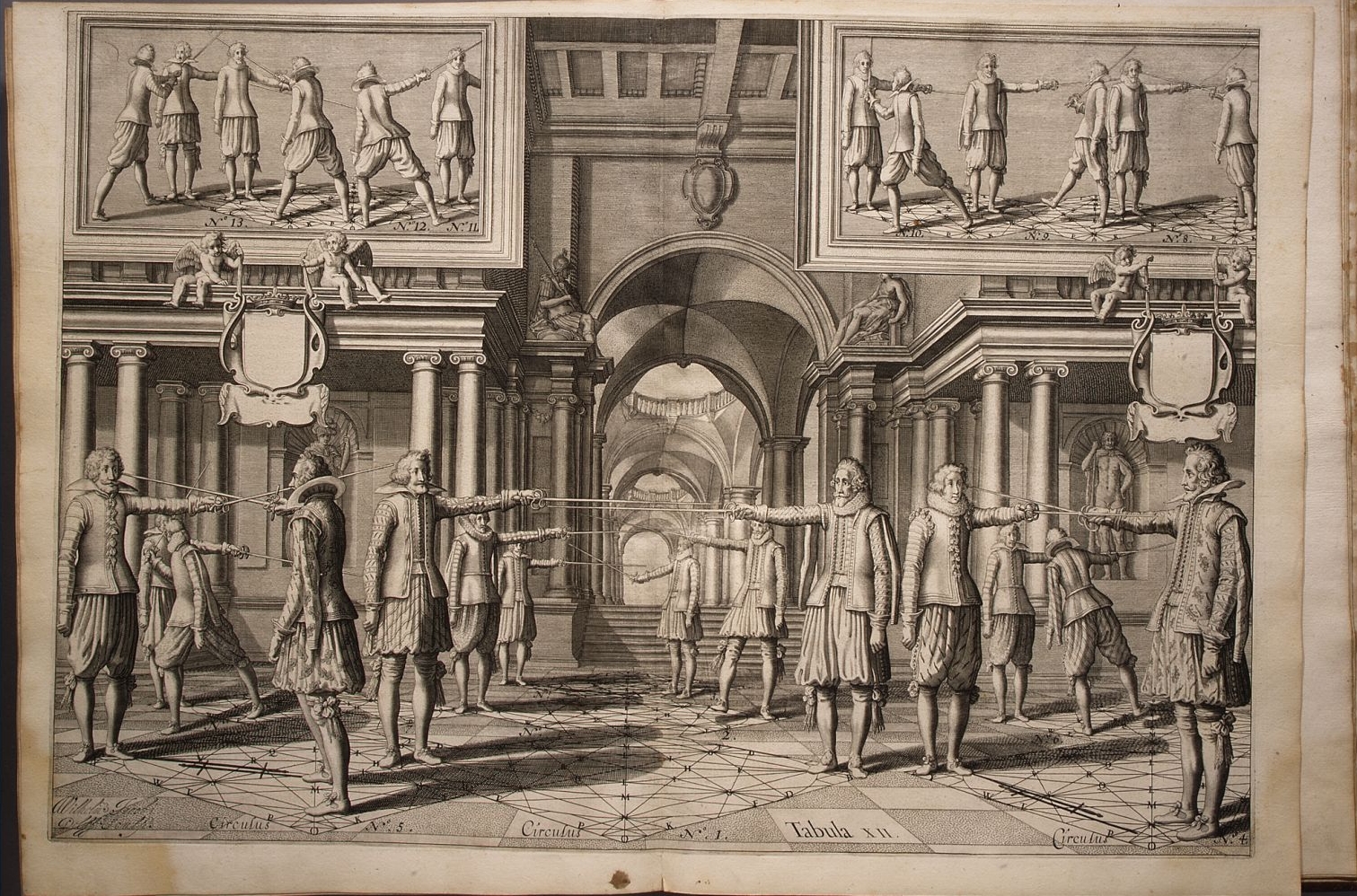
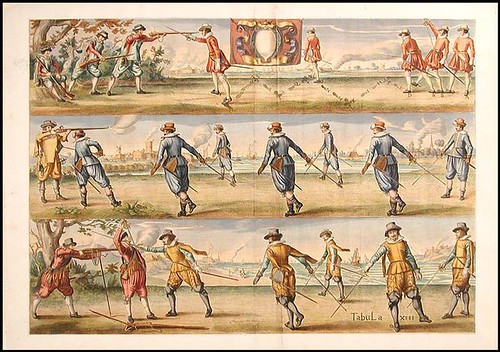
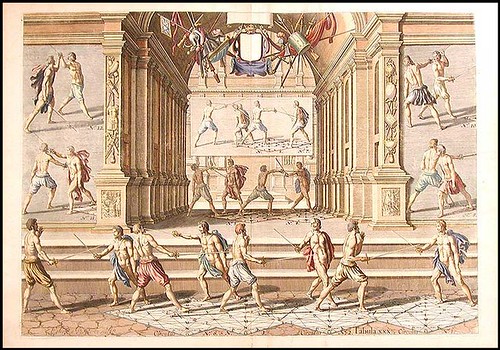
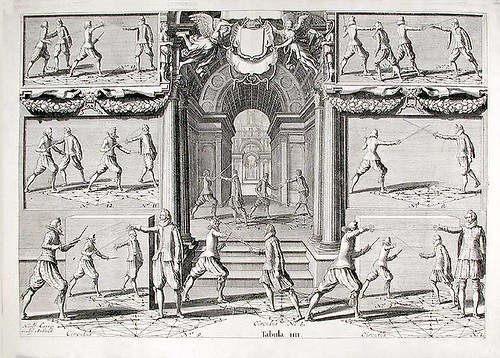
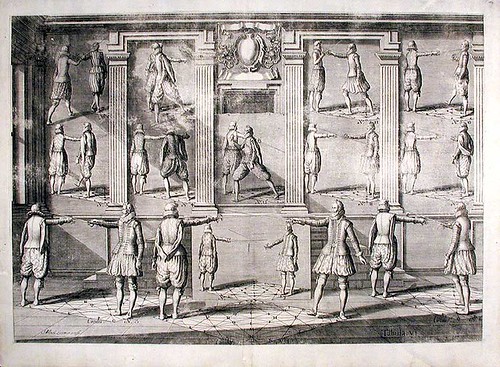
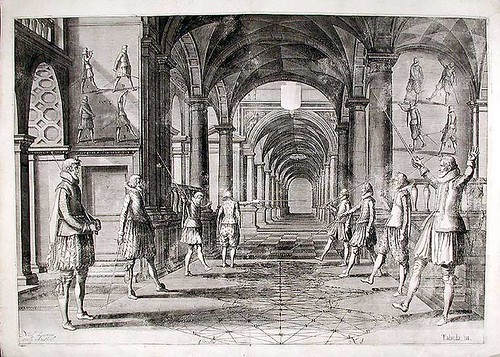
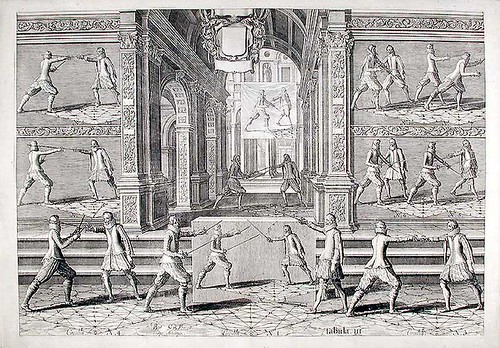
girard thibault academie de l'espee 1628


girard thibault academie de l'espee 1628


girard thibault academie de l'espee 1628


girard thibault academie de l'espee 1628


girard thibault academie de l'espee 1628


girard thibault academie de l'espee 1628


girard thibault academie de l'espee 1628


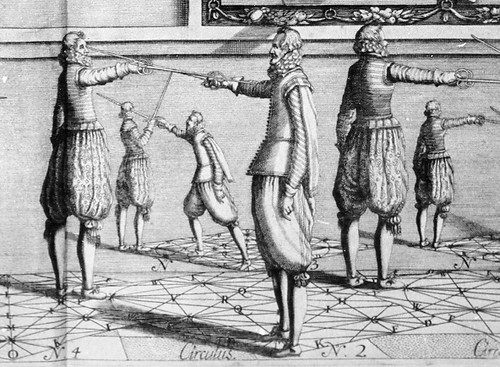
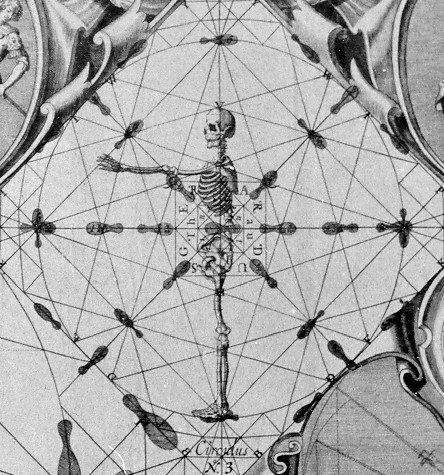
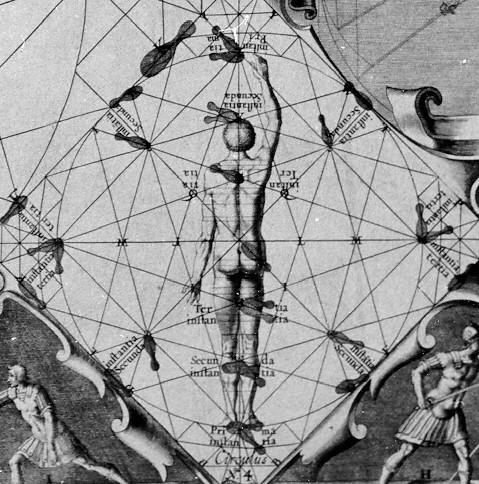
girard thibault academie de l'espee 1628 circulus detail


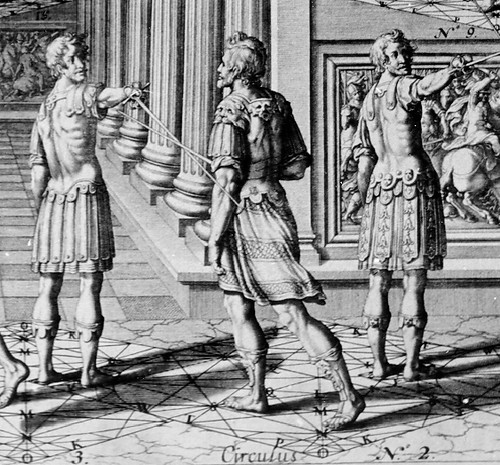
girard thibault  academie de l'espee 1628 detail


girard thibault  academie de l'espee 1628 detail


girard thibault  academie de l'espee 1628 detail


girard thibault  academie de l'espee 1628 detail


girard thibault  academie de l'espee 1628 detail

Between the 16th and 18th centuries swordplay experienced an evolution in technology and technique. The heavier broadswords which were often just used as bludgeoning weapons began to give way to lighter and narrower breeds, particularly the rapier, whose sharp point was better able to pierce a combatant and whose extra length allowed for both a greater reach and better defensive positioning.

These new weapons also became fashionable sidearms for use in civilian combat, duels and for purely sporting purposes. The cumbersome tactics employed with the older weapons, which relied on brute strength brought to bear on the cutting edge of the blades, were superseded by more dexterous skills and speed, where the tip of the sword and the lunge were emphasised. Fencing techniques came to be regarded as more of a science during the 16th century and were naturally influenced by the advancements that occurred during the Renaissance.

The Spanish school of swordsmanship - 'La Destreza' ('high level skill') - emerged as the leading theoretical system in Europe in the 1550s with a book published by Geronimo Carranza in which geometry became a primary source for insight into combat techniques. His pupil, Luis Pacheco de Navarez, expanded the theory in his own work published at the end of the century.

Navarez was to train a Flemish swordsman (and doctor, poet, artist, architect and occultist), Girard Thibault (Thibault d'Anvers), who became a Master in the Spanish fencing methods in the first decade of the 17th century. His accumulated knowledge, together with the advancements to the mathematical theories he made himself, were collected and published in 1630 (although the book bears a 1628 date) in the most elaborate and lavishly illustrated fencing treatise ever produced. Thibault first acquired royal patents for his work in about 1620 so it essentially took him ten years to finally get his volume released, and it included more than forty sumptuous double-page folio engravings by some sixteen of the best artists of the day (eg. Crispin de Passe, Pieter Serwouters, Schelte and Boetius Bolswert, Saloman Savery, Jakob Goltzius, Peter Isselburg, Pieter de Jode &c).

A central tenet of the Thibault thesis on Spanish swordsmanship is the idea of a magic or mysterious (as it was to contemporary observers) or Thibault circle - essentially the diameter of an imaginary ring on the ground in which the stance, attack and defensive positioning all take place. The size of this circle corresponds to the height of the swordsman to the tip of his outstrectched finger (seen in a couple of the above images). All of the tactical movements are described by circular and linear concepts and a knowledge of geometry is fundamental to exploiting the strongest positions.

"The dogmatic Thibault d’Anvers, who only admits perfectly defined calculations in his theories, speaks, however, of the feeling of the sword, the feeling of iron, referring to the very current proprioceptive and kinaesthetic qualities, rather than to improvisation and adaptability. His theories are based on mechanical reflexes and stereotypes with a strictness, completely geometric, inscribed in a mysterious circle which, according to him, is the basis of the science of fencing."
Thibault's text was "founded squarely on the on traditions of spiritual philosophy and practice and formed one of several practical expressions of Renaissance Hermetic occultism". Mystical pythagorean geometry is said to have found its place during the Renaissance in the esoteric arts of occultism. In that light, it's perhaps unsurprising that Thibault quotes at length from 'De Occulta Philosophia Libri Tres' by German magician HC Agrippa. All this is just to say that, rather than being a secret discipline based on the wearing of puffy trousers, Destreza may well be the only esoteric western martial art.

The full title in english of 'Academie de l'Espee' is:
'Academy of the Sword. Wherein is demonstrated by mathematical rules on the foundation of a mysterious circle, the theory and practice of the true and heretofore unknown secrets of handling arms on foot and horseback'. But the horseback section was never completed - Thibault died prior to release of the book.

 
Creative Commons License