Showing posts sorted by relevance for query monkey. Sort by date Show all posts

Sunday, February 10, 2013

Fables de Florian

1930s book illustrations by Benjamin Rabier


title page / frontispiece to Rabier's children's fable book : happy animals image + title text


monochromatic table of contents to kid's book with anthropomorphic cartoon animals around the border


bordered cartouche of cartoon smiling animals around donkey


monkeys + peacock illustrated as background to a children's book poem about them


various comic-like animal caricatures interspersed with a poem


illustrated lion, tiger + bear vignettes adjacent to verse


monotone kid's book poem with comicesque prints of crocodiles and fish around the margins


caricature scenes of farm animals with human expression next to verse


poem and illustrated scenes of kangaroo rat and mother with child


monochrome illustration vignettes of cats surrounding kid's book poem


cartoon scenes of fox and henhouse + verse


monochromatic endpapers embellished with all different types of animals with anthropomorphic human-like facial expressions


butterfly + insect related cartoon vignettes alongside a children's book page of verse


B&W cartoon print in kid's book of various scenes with child and dog next to a poem


ducks, fish + fishing in cartoon scenes next to poetic verse


illustrated children's book cover with happy animals and a child around a brook


The (translated) list of anthropomorphic fables in this Benjamin Rabier-illustrated version of Florian's original 18th century children's tales:
The cat and the mirror - Beef horse and donkey - Carp and carpillons - The cowboy and the gamekeeper - The Cat and the bezel - The blind and the lame - Mother the child and opossums - The Mole and rabbits - the sheep and the dog - The Cricket - The monkey magic lantern shows - The brouvreuil and raven - The young and the old hen fox - The child and the mirror - Two cats - horse and foal - The hedgehog and rabbit - The Phoenix - The cat and the sparrow - The linnet - The fox preaches - monkeys and leopard - Wild boar and nightingales - The rhinoceros and camel - The squirrel, the dog and the fox - Hare, her friends and two deer - Peacock, both goslings and diving - the monkey, the monkey and nuts - fox disguised - The owl, cat, rat and goose - The parrot confident - The snake and leech - The Parrot - The cats and rats - both farmers and the cloud - Leopard and squirrel - The lion and leopard - The dog - The donkey and the flute - The rabbit and Teal - The crocodile and sturgeon - The wasp bee - The warbler and nightingale.

Jean-Pierre Claris de Florian (1755-1794) was a French poet, romance and comedy writer, fabulist and pastoral novelist. He was elected to the Académie Française in 1788. Florian is best remembered for his children's fable verses, drawing from both traditional sources such Aesop as well as his own imagination.

Florian was arrested and imprisoned during the French Revolution and managed to avoid the guillotine during Robespierre's Reign of Terror. However, he died a year later at 39 years of age from an illness while still in jail.

Florian's most famous line might well be:
"Rira bien qui rira le dernier" or "He who laughs last, laughs best!"

Wednesday, July 14, 2010

Hairy Grotesques

Tête de singe souriant

Tête de singe souriant
[Smiling monkey's head]


Tête d'un satyre souriant
[Smiling satyr's head]


Tête chevelue et barbue d'un vieillard souriant
[Shaggy, bearded head of a smiling old man]


Tête de singe à la moustache enrubannée
[Monkey's head with ribboned moustache]


Tête d'un satyre aux sourcils levés
[Satyr's head with raised eyebrows]


Tête de faune aux rubans
Ribboned head of faunus*
(or maybe it's just 'creature')


Tête d'un satyre aux cornes nouées
[Satyr's head with tied horns]


Masque feuillagé d'homme grimaçant
[grimacing masked man with foliage]


Tête de satyre à la guirlande
[Satyr with head garland]


(click through for enlarged versions; some of the library stamps have been removed or attenuated)


This striking set of hirsute heads was produced in the second half of the 17th century by a French engraver named François Chauveau. It's as though he has travelled forward in time to select elements from Chewbacca / Planet of the Apes & Star Trek (Worf) to combine with the motif popularised during the Renaissance, the grotesque. So there's a certain charming naivety and abstraction to the works suggesting they may be early versions for a later, more sophisticated, suite of prints perhaps. We don't know the designer so it's hard to say.

Chauveau was a renowned engraver with royal pension and favour among his peers. A selection of more than a hundred and fifty of his prints, covering a wide variety of themes, is available from the Joconde portal, on behalf of a number of contributing French institutions.


Previously (that I can remember offhand) -

Monday, August 06, 2007

American Civil War Envelopes

Death to Traitors typographic envelope

'Death to Traitors'
E. Cogan
"Soldier figures, hanged men and American flags make up the phrase 'Death to Traitors'."


Devil and Whiskey - civil war cover

'Devil and whiskey'
"Devil sitting hunched over a whiskey barrel holding a flag."


Secession Whiskey - devil in civil war cachet

'Secession Whiskey'
D. Murphy's Son
"A giant goblet being hovered over by a skeleton. Inside the goblet is a pudgy, drunk (sleeping?) person. White envelope with brown ink. Image on left side.
One dose warranted to kill, at 40 rods."


Civil War secession as a dragon

'Secession as a dragon'
William Ridenburgh
"A knight wearing the American shield fights a dragon labeled 'secession'."


Secession Web - civil war caricature

'Secession Web - "Walk into my parlor," says the Spider to the Fly.'
D. Murphy's son, printer
"Davis as a spider catching the secession states in his web strung from the American flag. There is a skull and cross bones on his spider back and he is dripping blood and clutching Virginia. "


The Rebel States - Florida and Mississippi

'The Rebel States'
Reagles & Co., copyright holder
The devil holds the state seals of Mississippi and Florida and a Confederate flag.


Civil War envelope - Southern army propaganda

'Recruits wanted for the brave southern army - good pay, (in Confederate Bonds ) and good quarters, (in a horn.)'
D. Murphy's Son
"A dog and a monkey dressed in Confederate uniforms. The dog plays a drum. The monkey has a sword drawn and a flag showing stripes and skull and crossbones tied to his tail."


The Southern Vulture - envelope caricature

'The Southern Vulture "hard up".'
D. Murphy's Son
"Confederate soldier with rooster's head entering a pawn shop carrying a bail of cotton."


Running the Blockade - civil war/alligator satire

'Running the blockade'
"Man riding on the tail of an alligator with a crate labeled 'For New Orleans and a market'."


Confederated Chicken - civil war illustrative propaganda

'A Confederated Chicken after the Cock of the Walk, (Uncle Sam.) gets done with him.'
William Ridenburgh
"A chicken missing most of its feathers with a small sword suspended from it's body."


A Horse Marine of the C.S.A.

'A "Horse Marine" of the C.S.A.'
William Ridenburgh
"A plump figure with a naval hat on sits atop a wooden horse with a spyglass in his hand."


Civil War envelope - A Southern Gorilla

'A southern gorrilla, (guerilla)'
New-York Union Envelope Depot
"Gorilla (?) dressed in uniform with Confederate hat."
'Oh! for a nigger, and Oh! for a whip;
Oh! for a cocktail, and Oh! for a nip;
Oh! for a shot at old Greeley and Beecher;
Oh! for a crack at a Yankee school-teacher;
Oh! for a captain, and Oh! for a ship;
Oh! for a cargo of niggers each trip,
and so he kept oh-ing for all he had not,
not contented with owing for all that he'd got.'


An eminent Southern Clergyman

'An eminent southern clergyman, during an eloquent discourse is wonderfully assisted in finding scriptural authority of secession and treason, and the divine ordination of slavery.'
"Clergyman at the pulpit with bible on it with the devil standing beside him. Each has one hand on the open bible."


'An ASS-sault from a "Masked" Battery'
J Magee


Civil war bomb propaganda envelope

'To Cure Rebellion - This is the Pill that will Cure or Kill'


Lincoln v Davis boxing satire - civil war envelope

'Champion prize envelope, Lincoln & Davis in 5 rounds. 5th Round. '
J.H. Tingley, publisher.
"Lincoln stands inside "the champion belt" beside a pyramid labeled with all states. Outside the ring, four men, labeled east, west, north and south, waive hats. Flag, Liberty and eagle above. Cream envelope with black ink. Image covers sheet. Lincoln: You shall all have my impartial, constitutional and humble protection!"

"The printed envelope came into use in America in 1840 and was first used for advertising or satirical purposes. In the 1850s to 1860s 'corner cards,' with printing applied in the upper left-hand side of the front of the envelope, were common. By the onset of the Civil War, printed envelopes were already in use as a propaganda medium. Lithography was the main mode of printing used for envelopes, especially for colored designs. Printed envelopes were sold either as a single item or with matching paper."
The above Civil War envelopes come from the New York Historical Society collection - 490 images are available (click 'List items' top right).

Other collections - quite a bit of repetition, but they each have their merits:
I was hoping to find a descriptive essay that covered the printing, illustration and propaganda elements in something of a self contained nutshell (and maybe it's still out there) but there are various strands of interest through this lot:

Tuesday, April 29, 2014

Thai Fortune-Telling Manuscript

Hand-painted illustrations of zodiac figures accompanied
by Thai text from an undated paper accordion manuscript

"Thai Zodiac Signs are closely related to the Chinese Zodiac as both follow the same 12 year lunar cycle. In Thai zodiac signs the dragon is replaced by a “large snake” and in Northern Thailand an elephant may be used in place of the Chinese sign for the pig." [source]


variety of individual sketches of temples & stupa & people & mythological figures


colour painted illustration of mythological gods and devils


hand-painted figures and/or gods riding animals


8 colour figures from Thailand on a page : representing zodiac year


drawings of zodiac figures implying the Year of the Goat in East Asian astrological belief system


zodiac sigils indicating Thai Year of the Monkey


East Asian zodiac year figures hand-painted colour on paper


seated Thai God drawn above 4 white rabbits


assortment of coloured drawings of Thai people, gods & animals from zodiac astrological system


seated deity and a number of sketches of rats (zodiac)


sketch of 8 figures (mascot zodiac gods, humans and animals) - part of astrological divination system


colour drawing of astrological figures from Thai zodiac


group of fortune-telling zodiac system gods & animals


The summary of this manuscript from the Hollis Catalogue page at Harvard University tells us:
"Fortune telling manual based on a 12 animal zodiac. Four-page spreads include paintings of the animal for a specific year, along with mascot-figure for that year, the corresponding tree for that year, and scenes depicting good and bad marriage matches for that animal zodiac. The monkey, rooster, dog, and pig are fully illustrated but do not have any accompanying text."
The manuscript is dated to before 1844 (presumably because that's about the time when the earliest owner of the manuscript died). There's no other online commentary about this work that I can find. [SEE BELOW]
"According to Chinese astrology, a person's destiny can be determined by the position of the major planets at the person's birth along with the positions of the Sun, Moon and comets and the person's time of birth and zodiac Sign. The system of the twelve-year cycle of animal signs was built from observations of the orbit of Jupiter (the Year Star). Following the orbit of Jupiter around the sun, Chinese astronomers divided the celestial circle into 12 sections, and rounded it to 12 years (from 11.86)." (slightly edited from [source])
UPDATE: From a comment below---
"Maria Revere Balestier (daughter of Paul Revere and wife to the first American consulate to Singapore) was actually the first documentable owner and she sent it to Eliza Susan Morton Quincy (wife of the Boston mayor and president of Harvard). There is a note on the front cover of this manuscript that indicates it was sent in 1844 and letters between the two confirm that they shared objects and books, including a biography of Raffles. 
-Emilie Hardman, Houghton Library" 
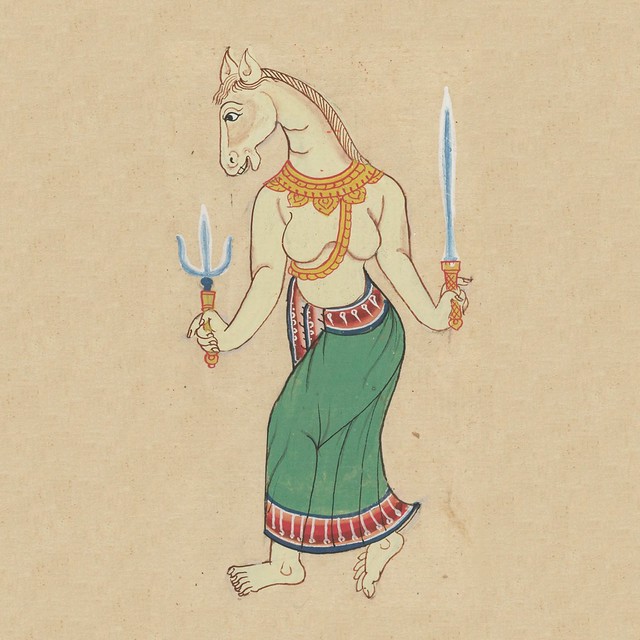
  Horse - zodiac manuscript figure
 The horse figure is cropped from its original setting 
& the background has been adjusted for layout purposes.

 
Creative Commons License