Showing posts sorted by relevance for query astronomy. Sort by date Show all posts

Saturday, March 22, 2008

Astronomical Handbook of 1718

Astronomical observations


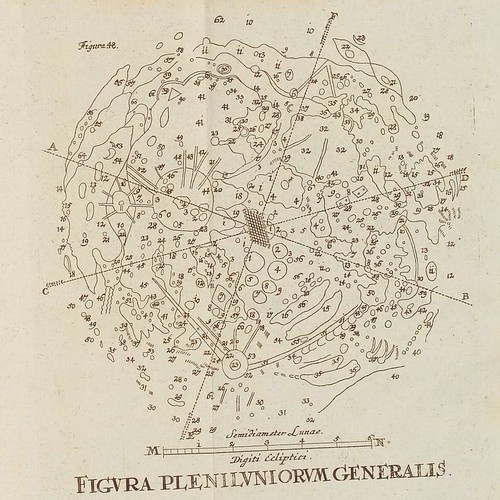
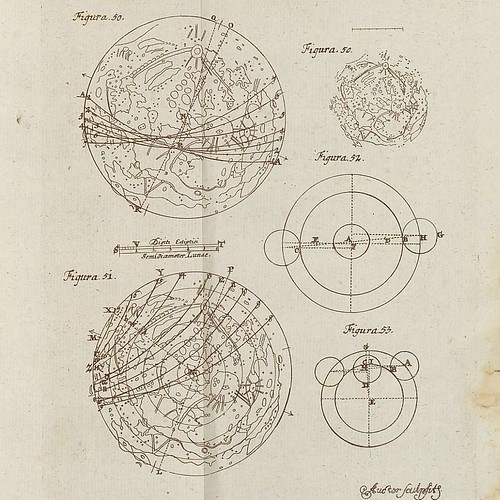
Figura Pleniluniorum Generalis


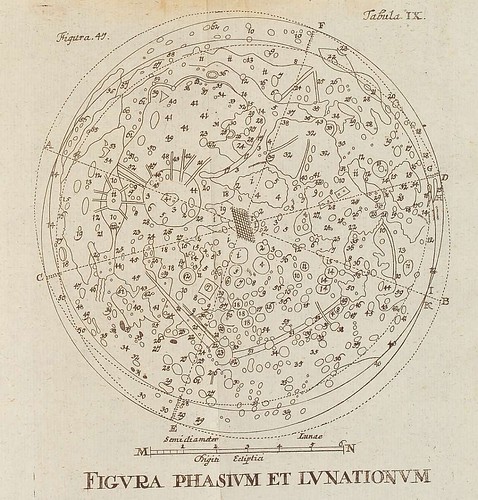
Figura Phasium et Lunationum


Atlas Portatilis Coelestis 1723


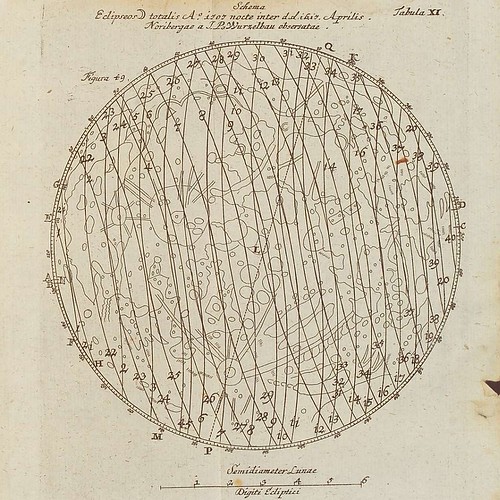
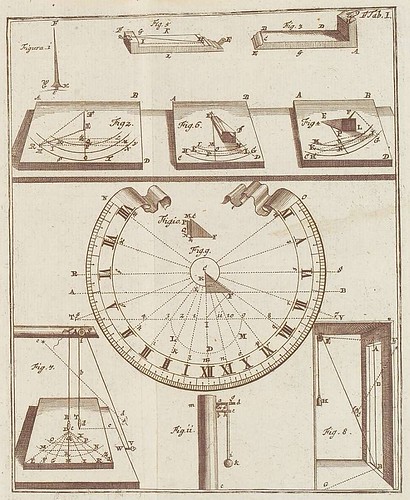
Eclipse tracking


Measuring eclipse


Astronomical measuring


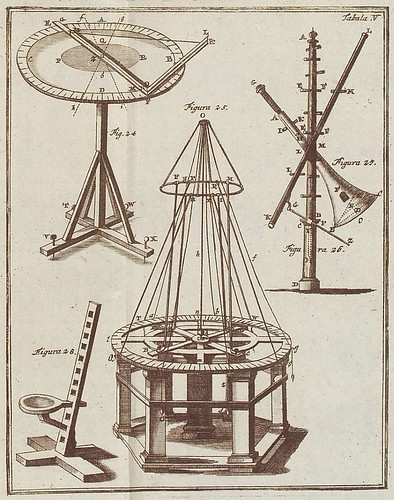
Astronomy devices


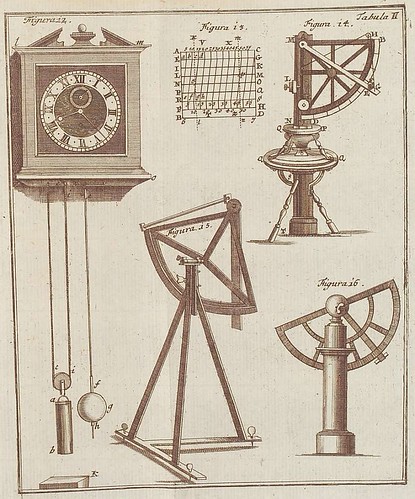
Celestial elevation measuring


Declination measurement


Pendulum measuring


Astronomy measuring


Telescopic devices

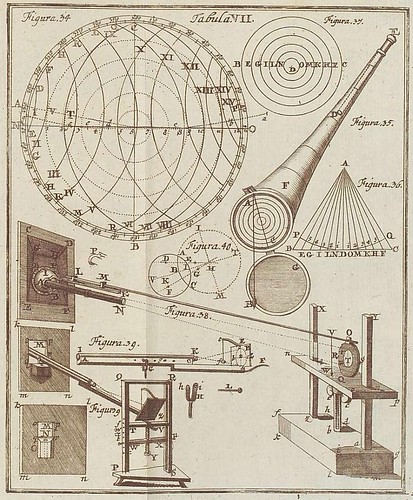
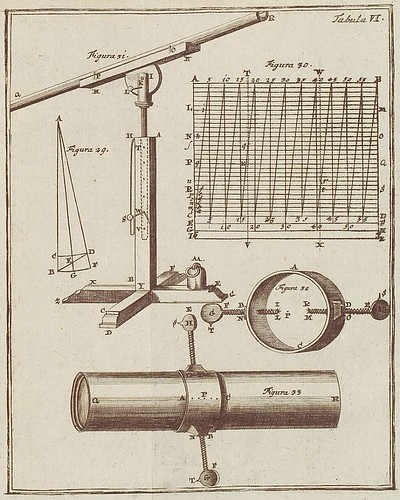
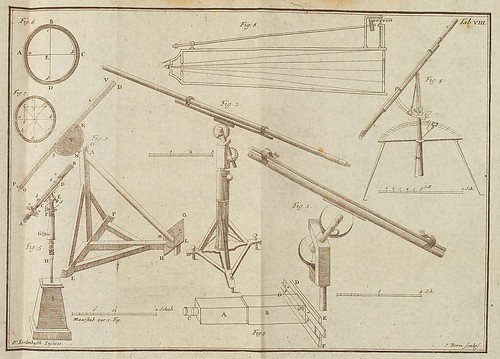
Johann Leonhard Rost (1688-1727) published the first practical astronomy text in Germany in 1718. It might also be described as the first ever German book devoted to astronomy, as the (very few) earlier works were either translations or simply chapters in larger publications.

Rost obtained a clandestine income from writing romance novels under a pseudonym (Meletaon) and studied his beloved astronomy in Altdorf, Leipzig and Jena. He was to become an assistant at the observatory in his birth town of Nuremberg, initially under its founder, Georg Eimmart, and later under Johann von Wurzelbau; but Rost made significant astronomical observations of his own and many of his findings appeared in scientific publications.

'Astronomisches Handbuch' from 1718 is online at Wolfenbütteler Digitale Bibliothek. The bulk of the illustrations appear above and they mostly pertain to the art of selenography (moon mapping) - I believe Rost's most significant observations related to solar and lunar appearances during eclipses and with the effects of the Northern Lights.

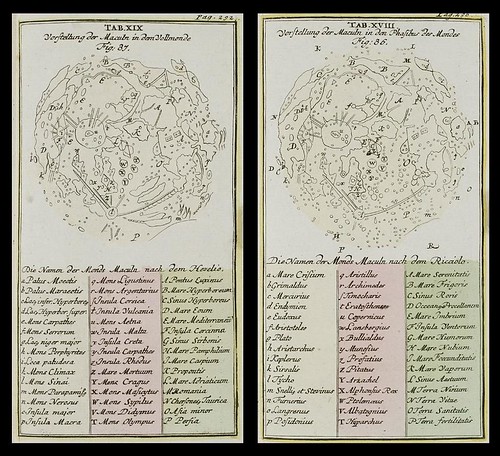
The coloured dual-image above comes from Rost's other main astronomical book, 'Atlas Portatilis Coelestis' (1723), available from the Linda Hall Library of Science, Engineering & Technology. The zodiac plates are based on the constellation arrangements of Johannes Hevelius (who was, incidentally, also the 'father' of moon mapping).

Friday, February 17, 2006

Notable Phenomena


Johann Dopplemayr (1677-1750) studied mathematics, physics and law. He was eventually appointed to the Chair of Mathematics at Aegidien Gymnasium in Nuremburg where he remained for some 50 years until his death.

He wrote a number of publications on geography, mathematical instruments, sundials and trigonometry and most notably compiled a book of historical biographies of 3 centuries of mathematicians from Nuremburg.

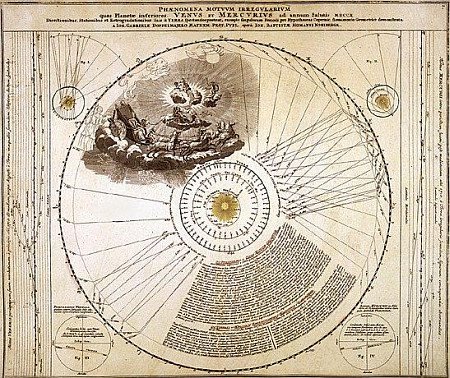
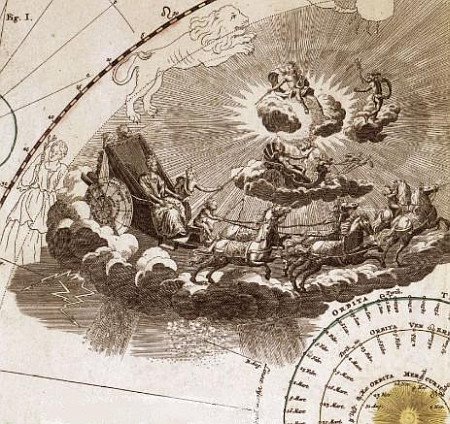
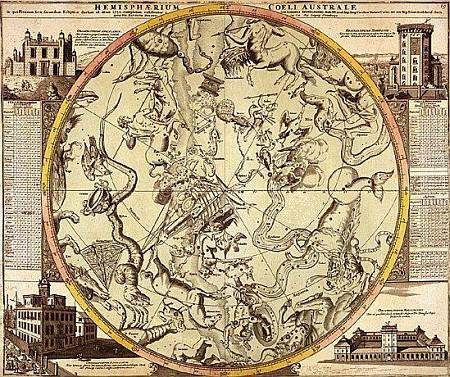
Dopplemayr collaborated with cartographer and engraver, Johann Homann for most of his (essentially unoriginal) astronomy publications. The above illustrations come from a work whose title page refers directly to Copernicus and Brahe but a debt is also owed to Pardies, Hevelius and Bayer and likely others - the origins of all the cosmological and astronomical diagrams in Dopplemayr's 1742 Atlas Coelestis is still not completely settled.

Atlas Coelestis in quo Mundus Spectabilis et in eodem Stellarum omnium Phoenomena notabilia, circa ipsarum Lumen, Figuram, Faciem, Motum, Eclipses, Occultationes, Transitus, Magnitudines, Distantias, aliaque secundum Nic. Copernici et ex parte Tychonis de Brahe Hipothesin. Nostri intuitu, specialiter, respectu vero ad apparentias planetarum indagatu possibiles e planetis primariis, et e luna habito, generaliter celeberrimorum astronomorum observationibus graphice descripta exhibentur, cum tabulis majoribus XXX is online at the website of Robert Harry Van Gent.

[I removed some of those little known but nevertheless recalcitrant common sense defying reappearing constellations: stampus libraria from the above illustrations]
Originally found via the eccentrically impressive MadMeg site, but thanks for the reminder D.

Friday, December 16, 2005

Flammarion


(Nicolas) Camille Flammarion (1842-1925) loved astronomy from the time he was a child growing up in France. He worked at the Paris Observatory for some time before establishing a private Observatory at nearby Juvisy.

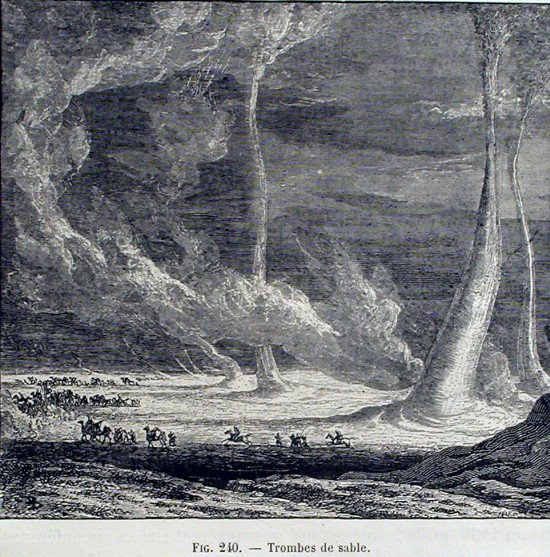
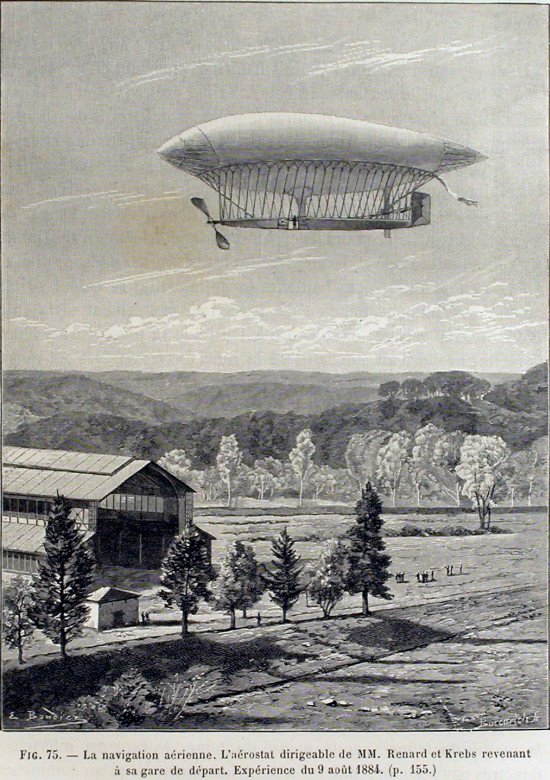
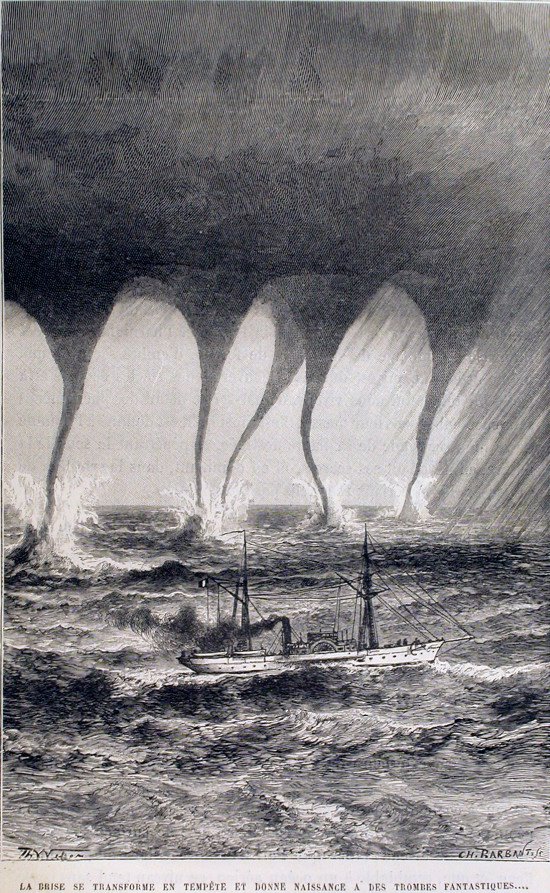
He is a somewhat enigmatic figure, establishing the Astronomical Society of France at the same time as promoting a belief in metempsychosis (transmigration of souls) and extraterrestrial lifeforms. He had a keen interest in meteorology which led him to take many balloon flights. Of his large body of published works, 2 standout as being responsible for popularizing astronomy towards the beginning of the 20th century - Astronomie Populaire (1880) and L'Atmosphere: Météorologie Populaire (1888).

Although I'm of the belief that all the images above are from these 2 books, I am not certain so take the truth of this post with a touch of salt. (not that I would ever claim authority in any entry at BibliOdyssey however I'm usually confident source material and background links have integrity but, like, this is the internet)

[Click the images above for larger versions]

Sunday, October 16, 2005

Welsh Phænomena


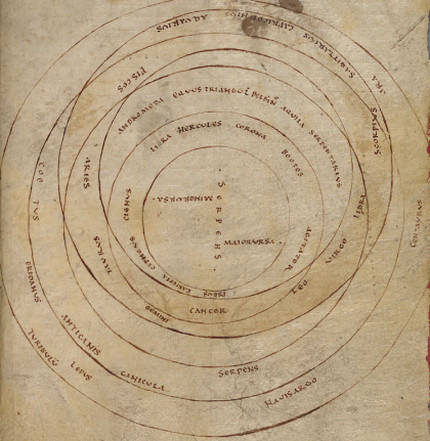
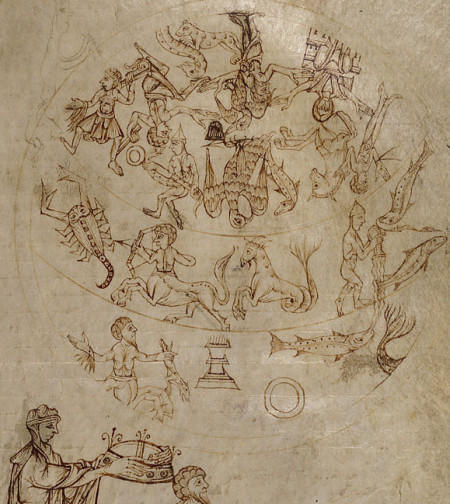
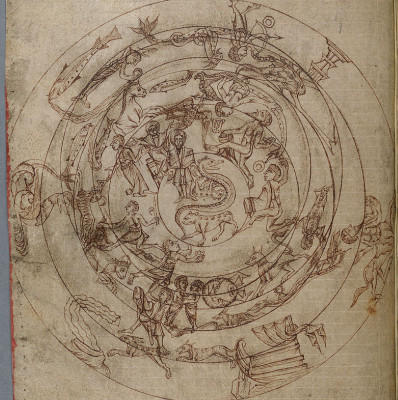
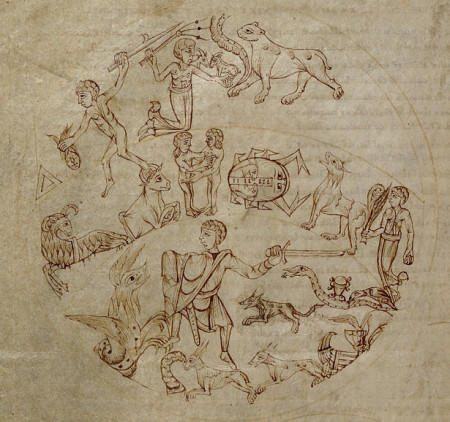
All these fascinating images come from the first half of a hybrid manuscript of medieval astronomy, this particular section being written in Caroline miniscule and illustrated on vellum (it seems) in c. 1000 AD.

We are told:

" The main text in the older part is the Latin translation by Germanicus (15 BC-19 AD) of the Greek Phaenomena by Aratus of Soli (c. 315-c. 240 BC), which describes the constellations. This is illustrated with a series of remarkable diagrams and coloured drawings reflecting the overlap between myth, astronomy and astrology at this period."
I was absorbed with this extraordinary book for over an hour. As the early 19th century owner wrote inside the front cover, "Astronomy and very curious".

Monday, November 15, 2010

Celestial Mechanics

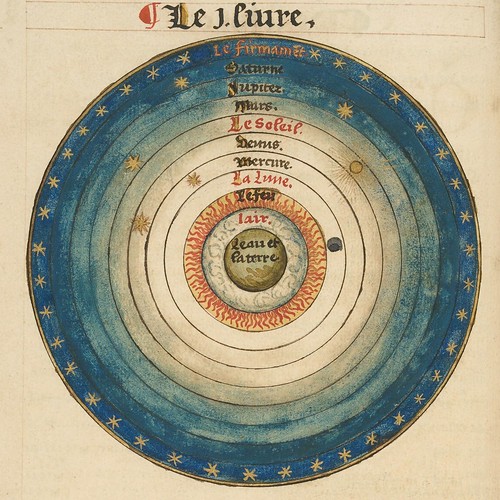
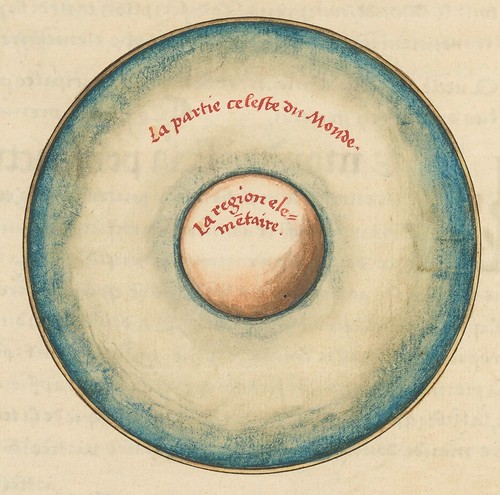
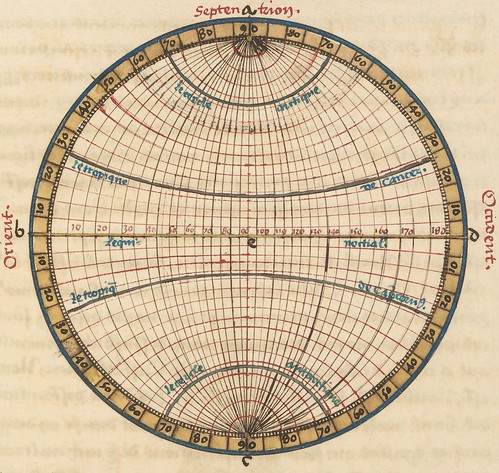
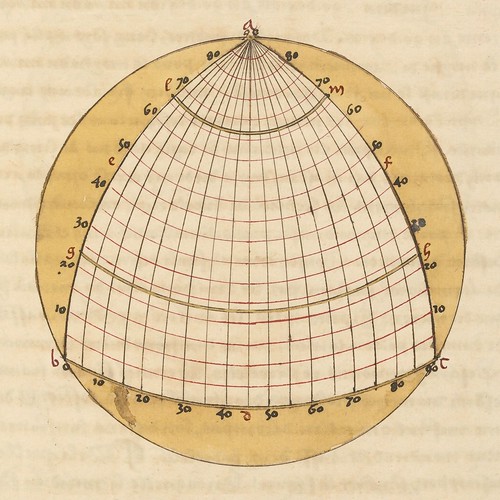
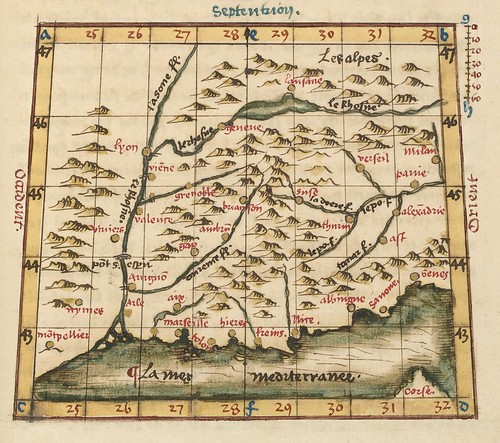
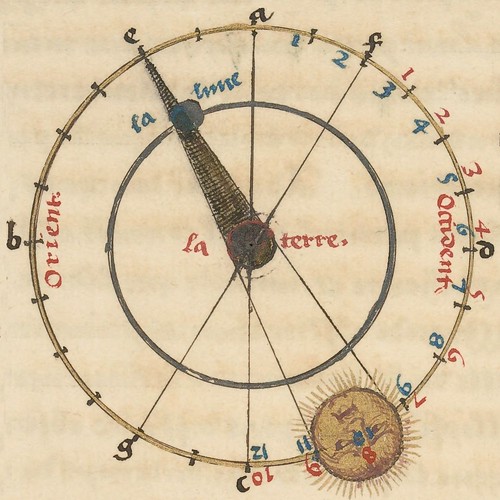
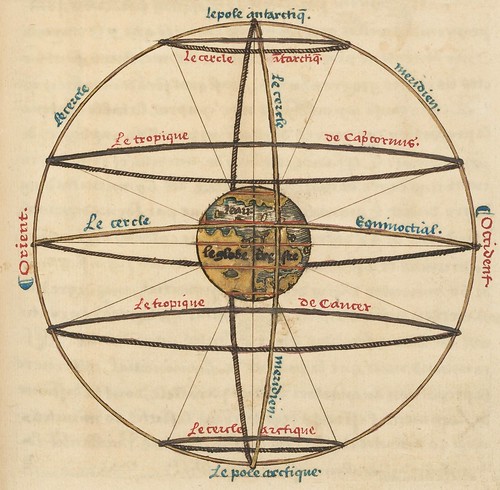
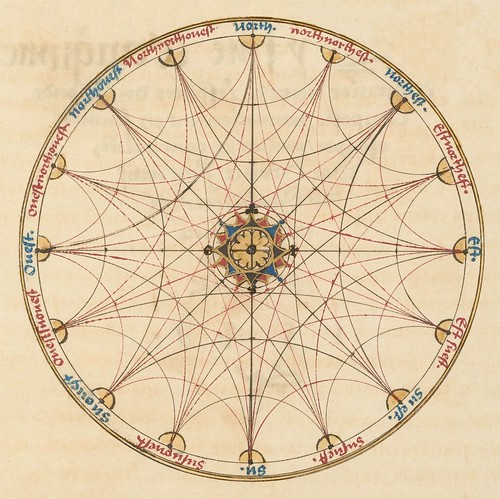
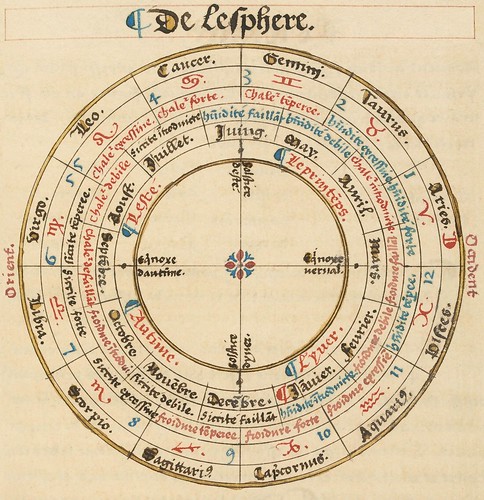
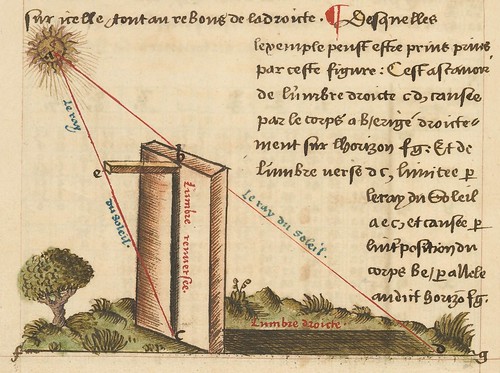
The images below are cropped and cleaned up somewhat from a newly digitised hand-written manuscript, online at Harvard University's Houghton Library: [MS Typ 57] 'Le Sphere du Monde..', 1549, by Oronce Fine.


Le sphere du monde by Oronce Fine, 1549 a

Geocentric (Ptolemaic) model of the universe


Le sphere du monde by Oronce Fine, 1549 b


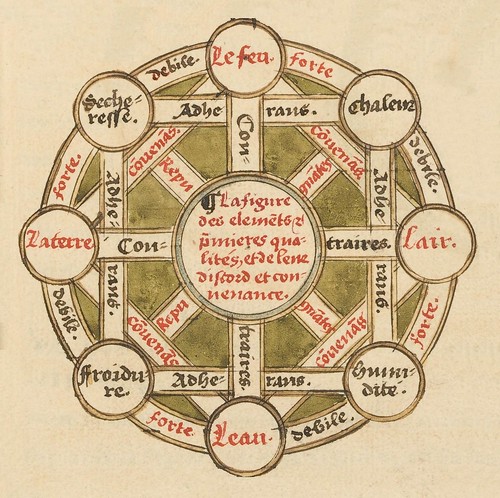
Le sphere du monde by Oronce Fine, 1549 c
The interaction between the four classical (Hellenic) elements
and their properties : earth fire air water -- hot dry cold wet


Le sphere du monde by Oronce Fine, 1549 d


Le sphere du monde by Oronce Fine, 1549 e
Compass rose with compass points


Le sphere du monde by Oronce Fine, 1549 fMeridians and circles of latitude


Le sphere du monde by Oronce Fine, 1549 gThis is a global map projection: attempting to render spherical surface
in a 2-dimensional plane (the last image below shows Fine's
most famous world map in cordiform -- heart-shaped -- projection)


Le sphere du monde by Oronce Fine, 1549 h


Le sphere du monde by Oronce Fine, 1549 i


Le sphere du monde by Oronce Fine, 1549 j


Fine, Oronce, 1494-1555. Le sphere du monde


Le sphere de monde by Oronce Fine, 1549 nAstrological calendar


Le sphere du monde by Oronce Fine, 1549 m


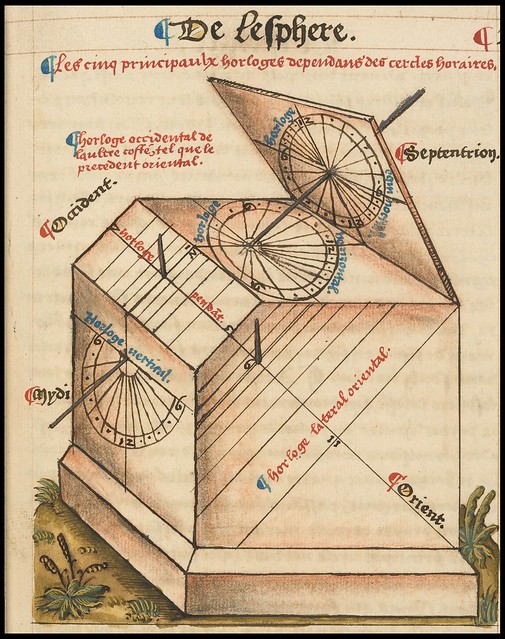
Le sphere de monde by Oronce Fine, 1549 k Sundial designs


Oronce Fine (or Orance Finé) (1494-1555) was a third generation physician from France. He was also a teacher and prolific author in the fields of mathematics, geography, cartography and astronomy and he held the chair in mathematics at the Collège Royal in Paris for more than twenty years.
"Fine was a quintessential polymath, equally at home in the workshop as in the study. Not only did he make and sell his own instruments, he also designed
maps, prepared the illustrations for his many books, and worked as an editor and
overseer in Paris’s bustling printing houses."1
Fine's prodigious output allowed for errors to appear in his published works however, and it was wildly exaggerated claims - for instance, he claimed to have squared the circle in myriad ways - that attracted contemporary criticism of his intellectual powers.

Until recently1, Fine's achievements in the history of scientific enquiry have been judged closer to footnote status than significant offerings. It has long been held that Fine was a mere populariser of scientific tenets outlined by his own teachers and predecessors and that he had made few, if any, original contributions to scientific thought. But a more sympathetic view of Fine has emerged with a re-evaluation of the leading role he played in elevating mathematics, in particular, to a position of high intellectual merit in Renaissance-era France.

Given his energetic pursuit of both theoretical and practical disciplines, Fine was uniquely placed to attract serious attention from royalty and nobility whose patronage was obviously important in advancing 17th century French scientific pursuits. Fine also published, or contributed towards the publication of, more than seventy books, in Latin, that were widely read in his own country and also throughout much of the Holy Roman Empire.
"Fine was much more representative of the mathematical culture of the period than the extraordinary figures who have tended to monopolise historians’ attention. Arguably, indeed, he did much more to shape the nature of that culture than many of those who are now more famous than him." [A Mosley]1
The current manuscript, dedicated to Henri II, from which the images above were drawn, is simply one example of Oronce Fine's diverse interests. The illustrations, in addition to the text, were produced by Fine himself. It was published in book form in the early 1550s but breaks no particular new ground and simply recycles ideas proposed by Aristotle, Ptolemy and Sacrobosco*.


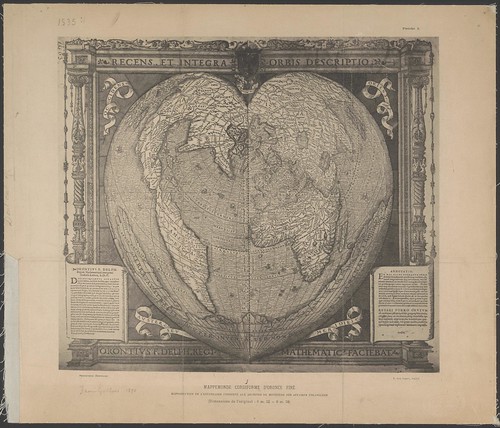
16th century world map - mappa mundi / terra australis
'Mappemonde Cordiforme d'Oronce Fine' {about 1534}
[this map is not in Fine's astronomy manuscript]

{Fine was noted for his cordiform or heart-shaped maps of the world. Another of his heart-shaped maps included the mysterious Terra Australis land mass - albeit joined to Antarctica - for the first time: LINK}
"Oronce Fine was one of the rare French geographers in the Renaissance to prepare maps of the world. This map is bordered with a handsome Renaissance decoration: two columns support a pediment bearing a Latin inscription signifying "A new and complete description of the world," interrupted in the middle by a coat of arms of France. Also to be noted is a vast southern land mass (Terra Australis), recently discovered but not yet explored." [source]

Thursday, September 05, 2013

Comet Sketches

The Comet Book ('Kometenbuch') 
is a 16th century album of
stylised watercolour sketches
of both comets and meteors
"The ancient Egyptians and Chaldeans [..] by a long Courſe of Obſervations, were able to predict the Apparitions of Comets. But ſince they are alſo ſaid, by Help of the ſame Arts, to have progoſticated Earthquakes and Tempeſts, 'tis paſt all Doubt, that their Knowledge in theſe Matters, was the Reſult rather of meer Aſtrological Calculation, than of any Aſtronomical Theories of the Cœleſtial Motions.

And the Greeks, who were Conquerors of both thoſe People, ſcarce found any other ſort of Learning amongſt them, than this. So that 'tis the Greeks themſelves as the Inventors (and eſpecially to the Great Hipparhchus) that we owe this Aſtronomy, which is now improv'd to Such a Heighth.

But yet, amongſt theſe, the Opinion of Ariſtotle (who wou'd have Comets to be nothing elſe, but ſublunary Vapours, or Airy Meteors) prevail'd So far, that this moſt difficult part of the Aſtronomical ſcience lay altogether neglected; for no Body thought it worth while to take Notice of, or write about, the Wandring uncertain Motions of what they eſteemed Vapours floating in the Æther; whence it came to paſs, that nothing certain, concerning the Motions of the Comets, can be found tranſmitted from them to us.

But Seneca the Philoſopher, having conſider'd the Phenomena of Two remarkable Comets of his Time, made no ſcruple to place them amongſt the Cœleſtial Bodies; believing them to be ſtars of equal Duration with the World, tho' he owns their Motions to be govern'd by Laws not as then known or found out. And at laſt (which was no untrue or vain Prediction) he foretells, that there ſhould be Ages ſometime hereafter, to whom Time and Diligence ſhou'd unfold all theſe Myſteries, and who ſhou'd wonder that the Ancients cou'd be ignorant of them, after ſome lucky Interpreter of Nature had ſhewn, in what Parts of the Heavens the Comets wander'd, what, and how great they were. Yet almoſt all the Aſtronomers differ'd from this Opinion of Seneca; neither did Seneca himſelf think fit to ſet down thoſe Phænomena of Motion, by which he was enabled to maintain his Opinion; Nor the Times of thoſe Appearances, which might be of uſe to Poſterity, in order to the Determining theſe Things.

And indeed, upon the Turning over very many Hiſtories of Comets, I find nothing at all that can be of ſervice in this Affair, before, A.D. 1337. at which time Nicephorus Gregorus, a Conſtantinopolitan Hiſtorian and Aſtronomer did pretty accurately deſcribe the Path of a Comet amongſt the Fix'd Stars, but was too laxe as to the Account of the Time; ſo that this moſt doubtful and uncertain Comet, only deſerves to be inſerted in our Catalogue, for the ſake of its appearing near 400 years ago."

'A Synopsis of the Astronomy of Comets' IN: 'Miscellanea Curiosa: Containing a Collection of Some of the Principal Phænomena in Nature, Accounted for by the Greatest Philosophers of this Age..' Edited by Edmund Halley, 1708. [Harvard || GBooks || Amazon |||| long ſ]
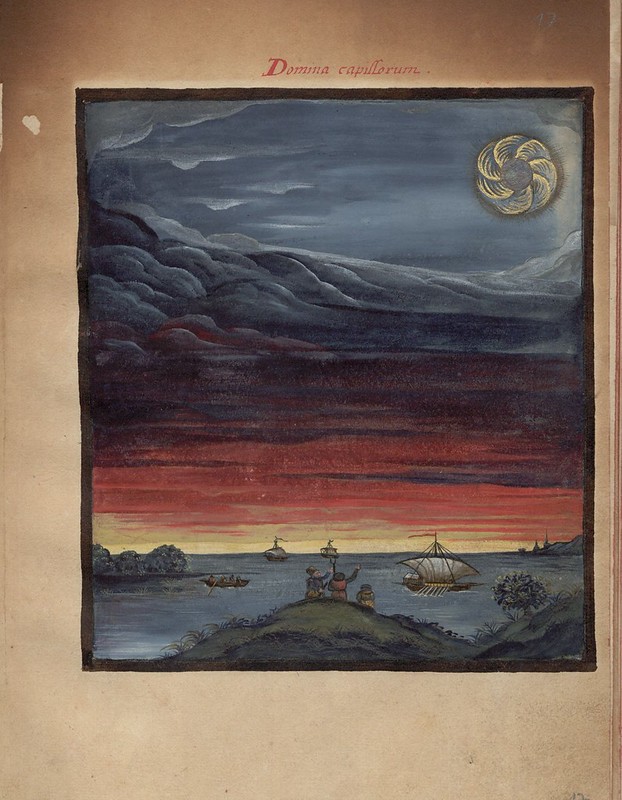


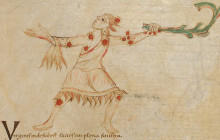
Domina capillorum a
Domina capillorum (Sol)


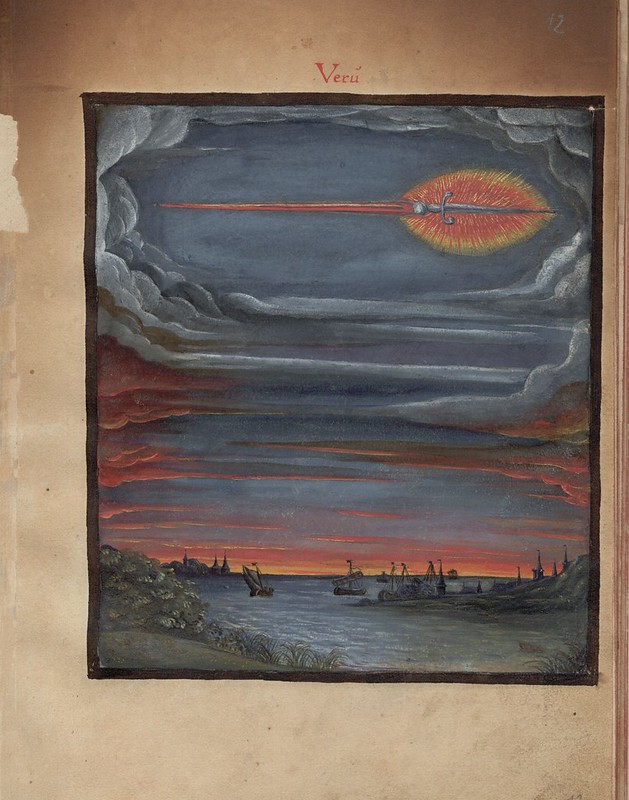
Veru a
Veru, ein Komet aus dem Jahre 69 n. Chr.
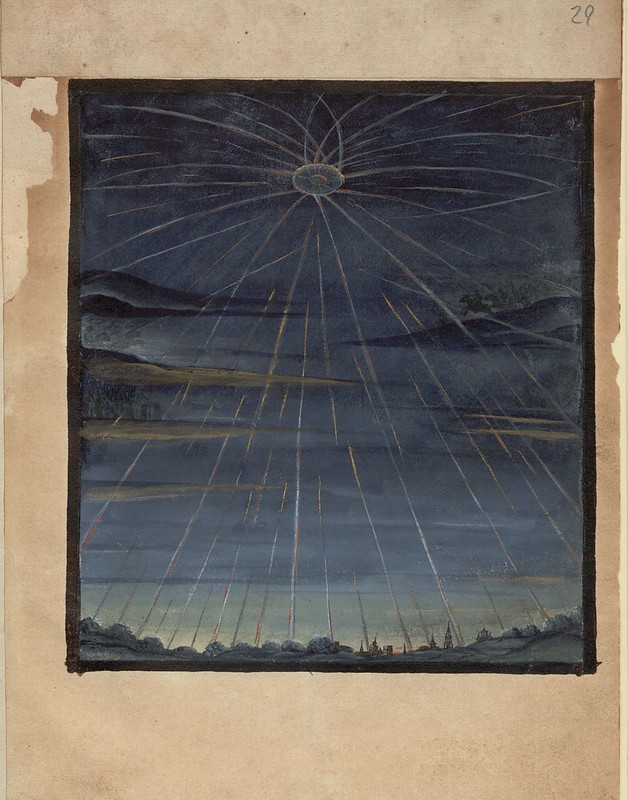


Unnamed a
?Pertica orientalis und occidentalis


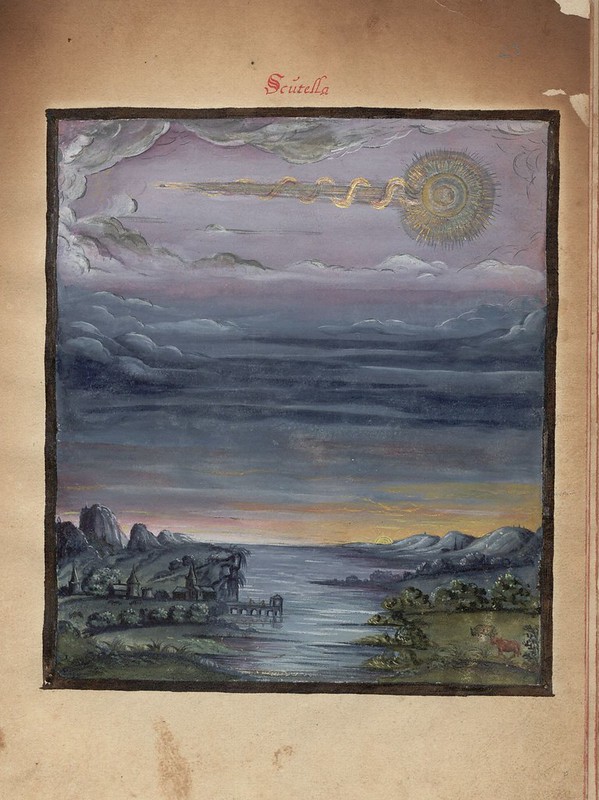
Scutella a
Scutella


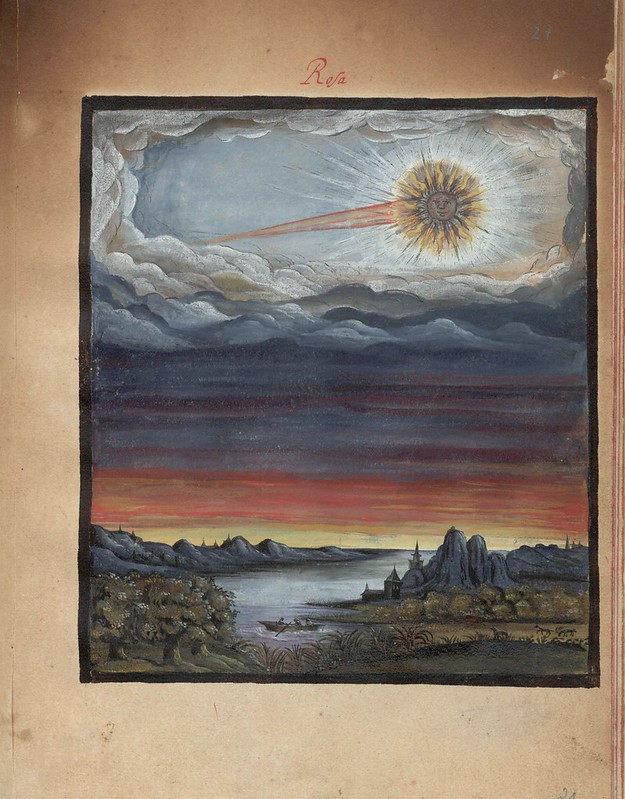
Rosa a
Rosa


miles a
Miles


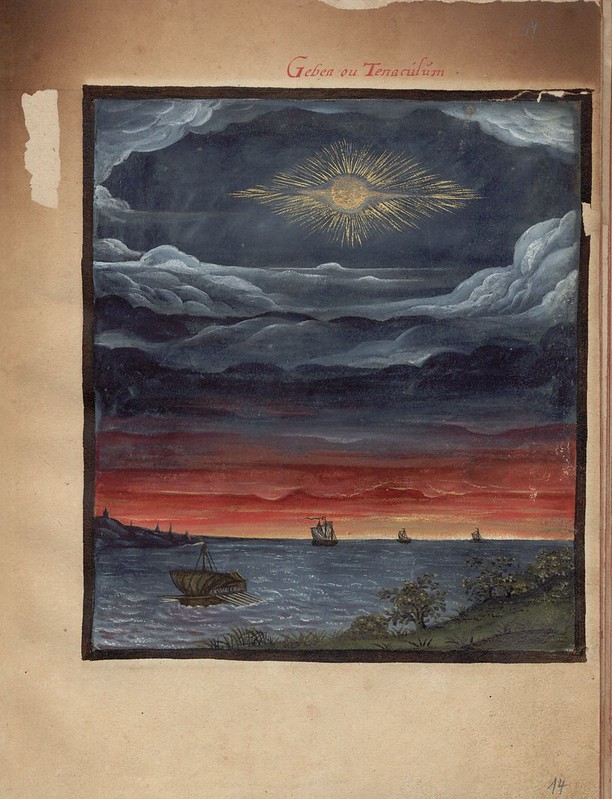
Geben ou Tenacusum a
Gebea ou Tenaculum (Luna) aus der Zeit Kaiser Neros


Etoiles courants a
Etoiles courants


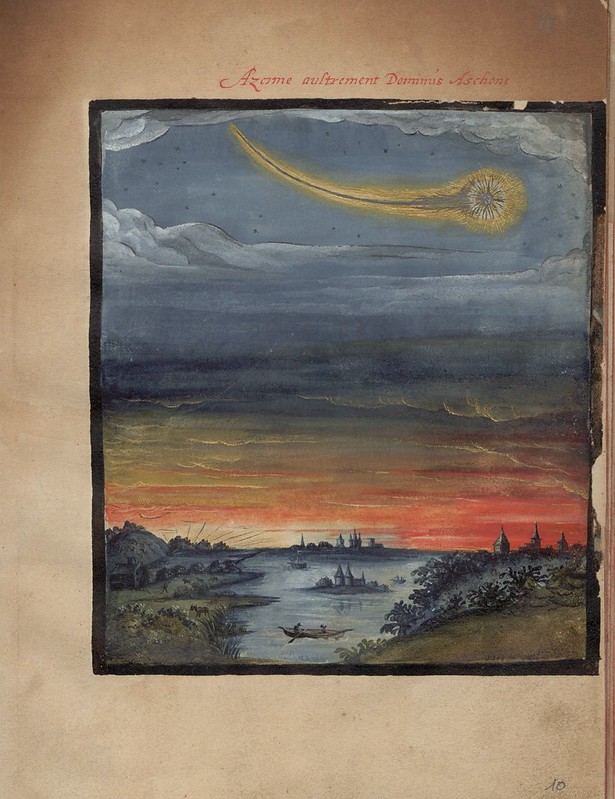
Azome austrement Dominis Aschone a
Aczime aultrement Dominis Aschone (Merkur)
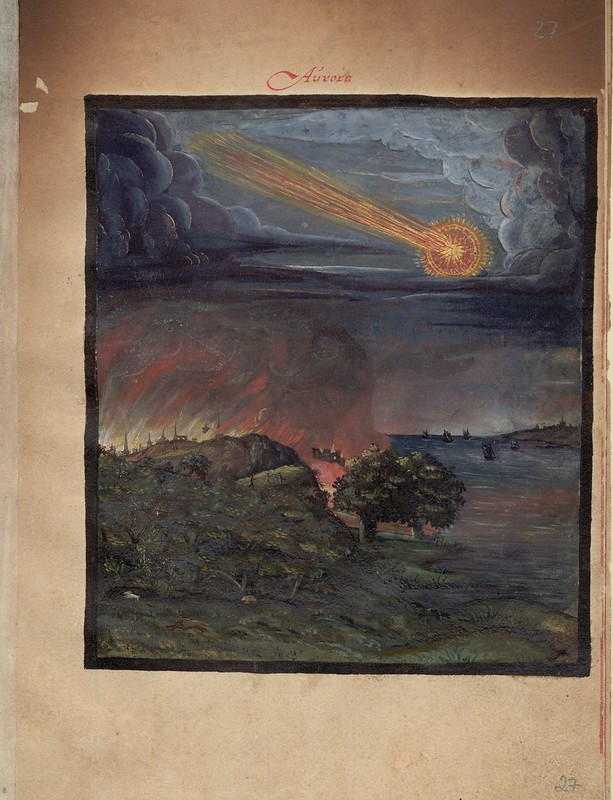


Aurora
Aurora oder Matuta (Feuer)


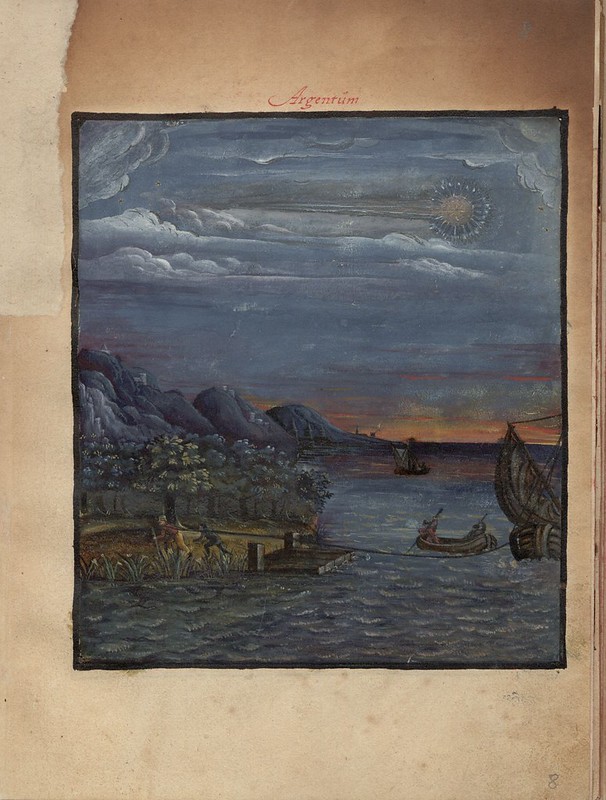
Argentium a
Argentum im Zeichen des Jupiters


'Kometenbuch' was produced in Flanders or NE France in 1587. Two editions are known to exist; the other copy is owned by the Warburg Institute in London, and contains near-identical sketches, but has an extra chapter of writing. The names of the author and illustrator are unknown. The text would appear to reflect the rather outlandish, or at least exaggerated, qualities we see in the painted miniatures. In other words, the text purports to compile a history of comet science from ancient times up to the late Medieval period, but it does so in such a way that the emphasis is on 'popularising' the content. Early Modern pop-science, if you will. So what began as factual depictions of celestial phenomena, morphed into spectacular genre paintings.

The writing isn't so distorted that it masks the true origins, however. Our author incorrectly (or pretentiously) names Ptolemy as a source - but the papers cited in 'Kometenbuch' contain no reference to comets at all. Instead, it has been determined that the true source for the manuscript contents lies with an anonymous Spanish book, 'Liber de Significatione Cometarum', published in 1238. The 13th century book contained astrological and astronomical information and observations from ancient history and was translated into many languages; one edition in simplified French from the 15th century likely provided the 'Kometenbuch' author's foundation material.

The painting scenes tend to follow from the descriptions in the text; for instance, comet Aurora was said to trigger wars, fire, strong winds and the like, which is why the corresponding image depicts burning houses, fleeing people etc. The Miles comet is described as being "as big as a horse" and the harbinger of upheaval to laws, social norms and hard times for royalty: cryptically sketched as a man defecating beneath a sky filled by a giant-tailed comet (the tails were said to carry the 'effects' from the heavens), while a perplexed owl looks on from a tree.

Throughout history, the appearance of these beautiful and colourful comets has been regarded as significant events. In general, people held superstitious beliefs about comets and were convinced that they were bad omens and associated with the forces of dark magic or a sign of punishment to come from displeased Gods. Comets 'announced' that war, famine, pestilence and other consequences of sinful behaviour were on their way. This kind of religious punishment explanation of comets persisted up until the 16th and 17th centuries in Europe, when the speculative literature (and illustrations!) gave way, over time, to a more scientific appreciation of the phenomena.


  • 'Kometenbuch' 1587, is available online from Universitätsbibliothek Kassel in Germany.
  • The majority of writing above is paraphrased from a translated manuscript commentary/bibligraphy book^: 'Kasseler Handschriftenschätze' c. 1985 by Hartmut Broszinski.
  • I am, for the manyeth time, deeply grateful for the translational assistance provided by typographer-extraordinaire, Nina Stössinger (@ninastoessinger). THANKS NINA!! Nina is studying again now, so if there's anybody out there who is very fluent in BOTH English AND German, and who wouldn't mind giving me some occasional translational assistance, please get in contact: gmail/peacay or @BibliOdyssey.
  • Thanks also to Harvard Library's John Overholt.
  • Previously: The Comet Book (includes more background links) and, in general: astronomy & astrology.
  • Addit: never let it be said that I d/won't allow criticism to appear here (however factually incorrect it may be - they regard the details of the write-up here - with which they disagree - the fault of 'the blogger'. Perhaps they ought to read all these bullet points. My opinion doesn't really surface. A lot of work and a few people were responsible for producing this commentary which, as noted, is essentially a summarised translation.)
  • This post first appeared on the BibliOdyssey website.

 
Creative Commons License