La Nature à Coup d' Oeil
or
Accidentally Anamorphic
"The panorama aspired not to artistic stance or synthesis, but to an encyclopedic gaze midway between that of some aeronautic insect and that of a real-estate sales agent."
[RA Potter]
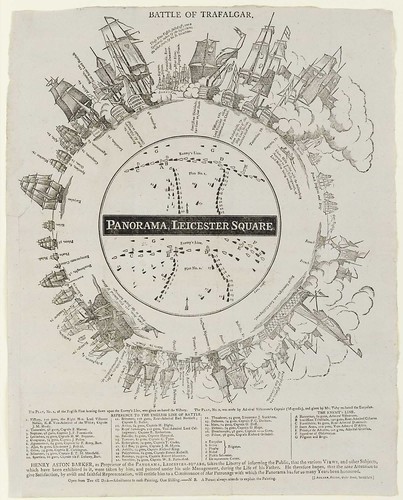
Battle of Trafalgar
The Plan, No. 1, of the English Fleet bearing down on the Enemy's lIne, was given on-board the Victory. The Plan, No. 2, was made by Admiral Villeneuve's Captain (Migendie), and given by Mr. Toby on-board the Euryalus.
Henry Aston Barker, as Proprietor of the Panorama, Leicester-Square, takes the Liberty of informing the Public, that the various Views, and other Subjects which have been exhibited in it, were taken by him, and painted under his sole Management, during the Life of his Father. He therefore hopes, that the
same Attention to give Satisfaction, by strict and faithful Representation, will entitle him to a Continuance of
that Patronage with which the Panorama has for so many Years been honoured.
Open from Ten till Dusk - Admittance to each Painting, One Shilling - NB. A Person always attends to explain the Painting. J. Adlard, Printer, Duke Street, Smithfield.

A Grand & Interesting Exhibition of a Moving Panorama of Trafalgar.
Representing the Splendid Victory achieved by Lord Nelson.
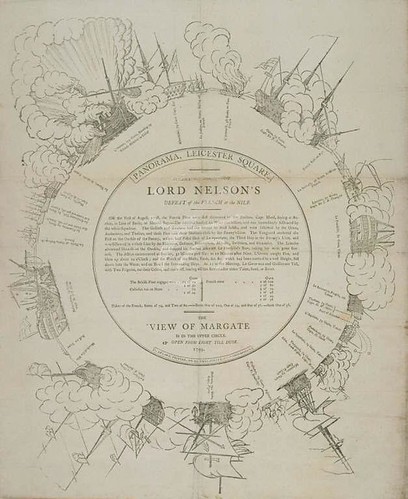
Lord Nelsons'
[1798] Defeat of the French at the Nile [1799]
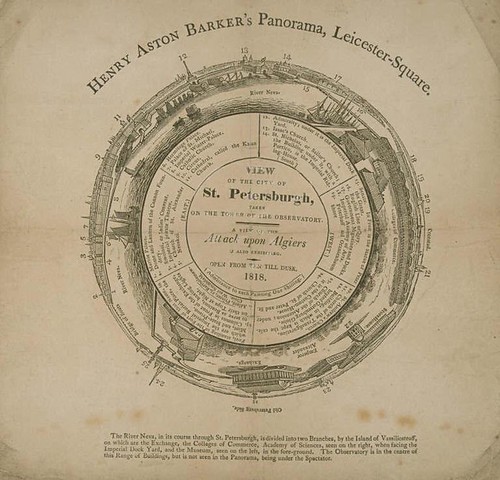
View of the City of St. Petersburgh, taken on the Tower of the Observatory.
A View of the Attack upon Algiers is also exhibiting. Open from Ten till Dusk. [1818]
The River Neva, in its course through St. Petersburgh, is divided into two Branches, by the Island of Vassiliostroff, on which are the Exchange, the Colleges of Commerce, Academy of Sciences, seen on the right, when facing the Imperial Dock Yard, and the Museum, seen on the left, in the fore-ground. The Observatory is in the centre of the Range of Buildings, but is not seen in the Panorama, being under the Spectator.
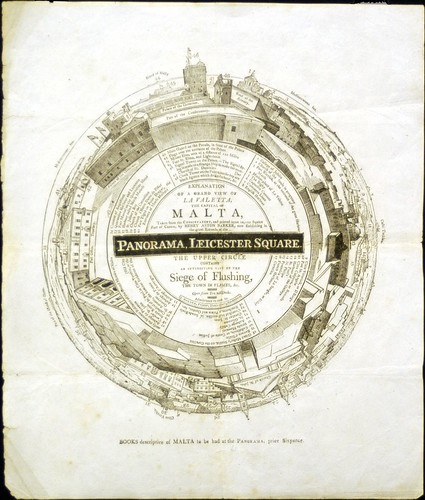
Explanation of a Grand View of La Valetta, the capital of Malta, Taken from the Conservatory, and painted upon 19,000 Square Feet of Canvas, by Henry Ashton Barker, now Exhibiting in the Great Rotunda of the Panorama, Leicester Square. The Upper Circle contains an interesting view of the Siege of Flushing, the Town in Flames &c.
Open from Ten till Dusk. Admittance to each 1s. Adlard, Printer, Duke Street, Smithfield.
Books descriptive of Malta to be had at the Panorama, price Sixpence.
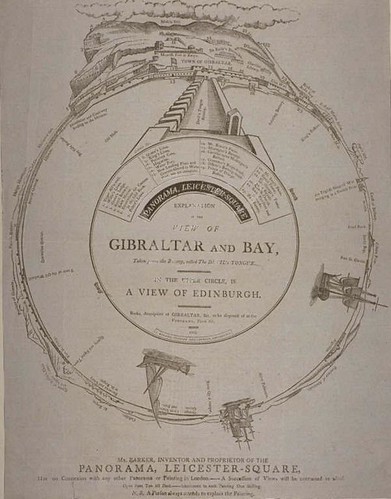
Explanation of the View of Gibraltar and Bay
(?)Taken from the Battery, called the Devil's Tongue
Mr Barker, Inventor and Proprietor of the Panorama, Leicester-Square, has no connection with any other Panorama or Painting in London. [1805]
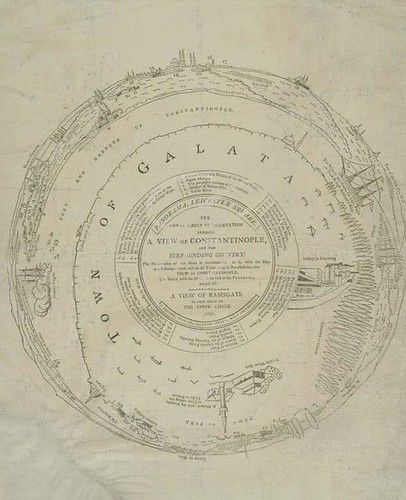
The Tower Circle of Observation [.?.]
A View of Constantinople, and the Surrounding Country
[..?..]
A View of Ramsgate is now [.?.] in the Upper Circle [1801]
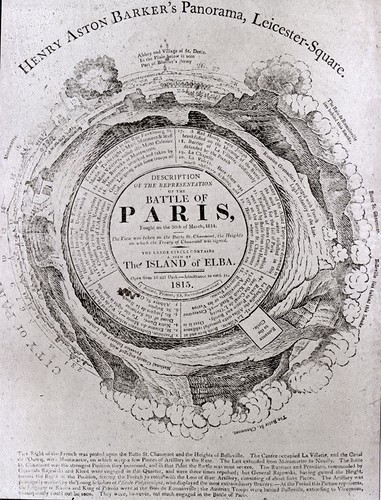
Description of the Representation of the Battle of Paris, Fought on the 30th March, 1814.
The View was taken on the Butte St. Chaumont, the Heights on which the Treaty of Chaumont was signed.
The Large Circle Contains a View of the Island of Elba. [1815]
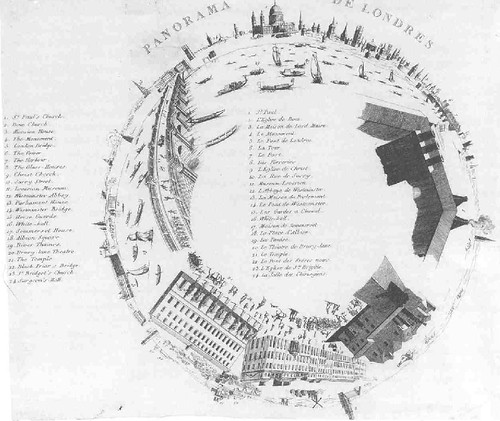
Panorama de Londres
{bilingual legend}

Panorama of London from Westminster to the Tower in a fan-shape, after the panaorama of Thomas Girtin. 1803 - Print made by François Louis Thomas Francia.
(nothing to do with the Panorama, save for subject/style)
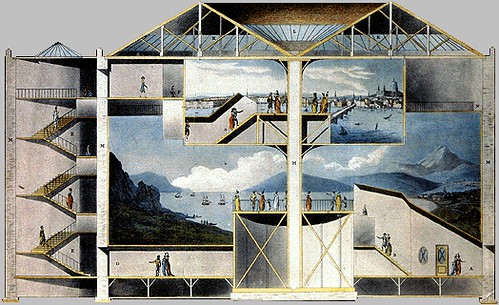
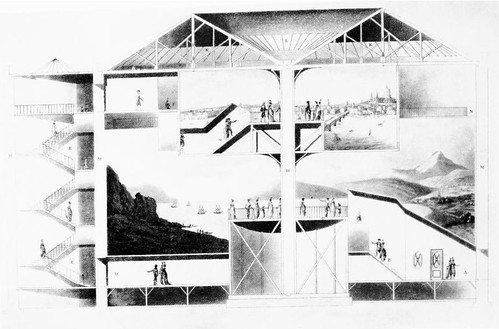
Colour and B&W version of 'Section of the Rotunda, Leicester Square' IN:
'Plans, and Views in Perspective' by Robert Mitchell 1801. (Mitchell was the architect responsible for building the rotunda)
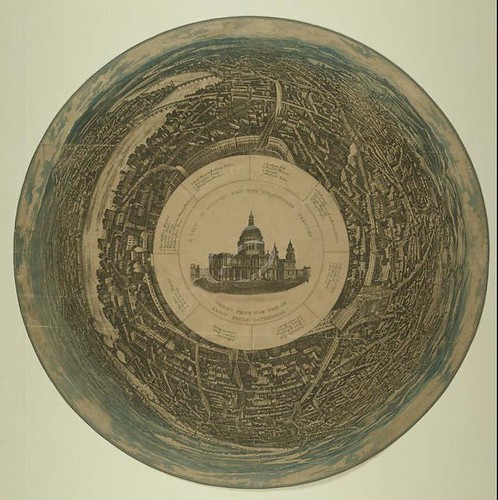
London from St Paul's Cathedral as if viewed through a camera obscura; with a view of St Paul's Cathedral in the centre. 1845.
(again, the print is not directly related to the Panorama of Leicester Square)
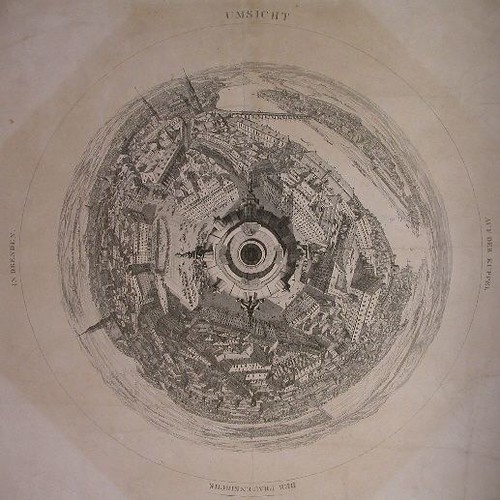
Cyclorama, taken from the Frauenkirche in Dresden. Engraving by Karl August Richter, 1824.
(and again: not related to the Panorama)
'Along the River During the Qingming Festival' (scrolls right to left)
18th century remake of a 12th century scroll painting by Zhang Zeduan.
This Chinese panorama painting "captures the daily life of people from the Song period at the capital Bianjing, today's Kaifeng. The theme celebrates the festive spirit and worldly commotion on the Qingming Festival, rather than the holiday's ceremonial aspects such as tomb sweeping and prayers. The entire piece was painted in handscroll format, and the content reveals the lifestyle of all levels of the society from rich to poor as well as different economic activities in rural areas and the city." [source]
Now
THAT'S a panorama!
-----------------
Anamorphosis (a. anamorphic) refers to the ingenious artistic technique of distorting the perspective of a picture when viewed from the normal reference point or angle. The apparent distortion disappears and a regular image emerges when the angle of viewing is changed or the image is observed using a curved mirror. Holbein's 'The Ambassadors'* is probably the most famous example of the mirror type. See: one, two. Some of the panorama flyers exhibit the phenomenon in the way the buildings are distorted and curved to conform to the curvature of the horizon/earth.
-----------------
The story goes that the Irish painter, Robert Aston Barker
(1739-1806), was sketching the city of Edinburgh from Carlton Hill
* in 1787 when he came up with the idea of reproducing the scene as a painting on a huge canvas that could be hung all the way around the inside of a large cylindrical container. The idea was for an observer in the centre to be encircled by a view without the perception boundaries of a regular painting's frame. In this way, he hoped to have the painted scene completely fill an observer's field of vision, making the experience as close to 'real' as possible. It would become the first immersive virtual reality.
Barker obtained a patent for his design in 1787, which he called
'La Nature à Coup d'Oeil' (nature at a glance). A purpose-specific building (rotunda), based on Barker's plans, was opened in Leicester Square in London in 1793 to great acclaim (two identical cross-section schematic images can be seen above). By this time, either Barker or a friend of his coined the term
panorama ('all view') which would be applied both to the circular painting and to the structure in which it was hung.
The Leicester Square rotunda was 11 metres high and 26 metres in diameter and was configured so to allow the simultaneous display of two panoramas, one upstairs, one below. Traditional subject matter consisted of panoramic city views, land and sea battles, together with exotic location scenes (views of Athens and the Arctic region would prove to be the most popular). Visitors were admitted through a dark passage to heighten the sensation of entering another world. The umbrella roof allowed the panorama paintings to be lit by natural light entering from directly above each painted canvas. Shadows cast by visitors angled towards the centre of the structure so they didn't fall on the painting and break the illusion. In the sea battle panoramas, the viewing platform was sometimes made to resemble the deck of a ship. The upper and lower limits of the visual field were draped to make the vista appear endless.
The combination of art and technical innovation was a very popular spectacle. Visitors were astonished and sometimes disorientated by the panorama and the inability to get a proper perspective:
“[It] was so designed that two of the forces which militate against perfect illusion in a gallery painting—the limiting frame and standards of size and distance external to the picture itself—were eliminated…The intrusive elements of the spectator’s surroundings being blacked out, the world in which they were entwined consisted exclusively of the landscape or cityscape depicted on the canvas suspended thirty feet away.” [Richard Altick, 1978]
Exhibition spaces were opened in other cities, both in the UK and on the continent. The panorama paintings were of course portable, so after a season in London, they might be packed up and shipped to another venue. Other entrepreneurs set up competing ventures and introduced their own variations and the form ultimately became most popular in America, particularly during the 1840s-1850s, with the adopted name of cyclorama.
The Barker Panorama had handbills and programs printed which, for about the first fifteen years at least, provided an illustrated legend or key - as we see above - that unintentionally resembled an anamorphic image. Originally they simply wanted to give some sense of the 360-degree novelty of the exhibition and this necessitated presenting the subject matter in distorted perspective. There was an obvious emphasis on promoting the sensational aspects of a new form of visual entertainment, despite the fact that the keys were difficult to read and had no clear starting point.
Eventually, as the novelty of the spectacle wore off and/or became very widely known, the panorama legends were modified and displayed as two rectangles, without distortion, and could be more easily followed and read from left to right. This development coincided with a change in emphasis from the visual illusion aspect to the presentation of geographical accuracy. Barker (and subsequent entrepreneurs) had always highlighted the difficulties and extremes of conditions faced by the sketch artist to bring each panorama to the public. Extravagant notices told of the insider assistance provided by foreign envoys, for example, in gaining unique and updated information and the latest changes to the skylines of target locations. There were some ten or more versions of the Constantinople panorama made over fifty years, each subsequent painting said to be more complete, more contemporary than its predecessor.
The rotunda in Leicester Square closed in 1863 and the entertainment form suffered its greatest decline in patronage with the advent of moving pictures. Still, panoramas - in one form or another - have never completely disappeared from the cultural repertoire available in many countries.
- Let me just say that I hate this post and all who sail in her. It took days to find all these images. It's probably equal in search difficulty to outfitting the Zoomorphic Calligraphy post. That's why we have non-handbill pictures here and also why the quality of some of the images is only so-so: I originally couldn't find enough material. So I had to walk away for a while.
- Particular thanks go to Jonathan Potter Maps who went to the trouble of scanning and providing a larger version of the Malta image than the one they have displayed at their site.
- Magic search terms are always logical and obvious after the fact. In this case "key to panorama" led to a huge and frustratingly wonderful database of images that was ultimately the source for about half of the images above: "The City of London Libraries and Guildhall Art Gallery is host to COLLAGE, an image database containing over 20,000 works of art from its collections." But all their images are instrusively watermarked (I've removed/reduced these in the pictures above).[search page]
- The Panorama Effect exhibition site from Newman Library at Baruch College, The City University of New York.
- Adventures in Cybersound from Dr R Naughton compiles excerpts and images from a lot of sites on panoramas.
- Well timed: "An American artist is to unveil a giant "E-Cyclorama" as part of an exhibition in the Edinburgh Art festival, which begins"
on Thursday yesterday. (the short film is worth watching - the artist's name is Sanford Wurmfeld)
- 'Panorama's, Painted and Photographic' from Panorama Mesdag ("the oldest 19th century panorama in the world in its original site" - Holland)
- Panoramic paintings worldwide [links] ( from: International Panorama Conference)
- Panoramic painting.
- Life Before Television: Low-tech Magazine, March 2008.
- 'The Panorama: History of a Mass Medium', 1997 by Stephan Oetterman seems to be the modern authority on the subject (cited all over the place in ref. to panoramas) [good review by RA Potter]
- 'The Encyclopedia of Ephemera: A Guide to the Fragmentary Documents of Everyday Life for the Collector, Curator, and Historian' by Rickards, Twyman &c, 2000. This looks to be a really good book (Amazon)
- 'The Orient on the Victorian' Stage By Edward Ziter, 2003.
- 'The Panorama' by Bernard Comment, 1999.
- 'Between the Virtual and the Actual: Robert Barker's Panorama of London and the Multiplication of the Real in late eighteenth-century London' IN: Romanticism on the Net (Issue 46) by Peter Otto, 2007.
- Via ME, following a recent reminder from PGA.







![L'Assiette au Beurre (refroidis) 1904 [coconino-world.com]](http://farm4.static.flickr.com/3029/2973685617_b3812f14d4.jpg)