Ornament designs from about the 1920s
printed by the pochoir stencilling technique.
"Pochoir is a refined stencil-based technique employed to create prints or to add color to pre-existing prints. [It] was primarily used to create prints devoted to fashion, patterns, and architectural design and is most often associated with Art Nouveau and Art Deco. [..]
Pochoir begins with the analysis of the composition, including color tones and densities, of a color image. Numerous stencils were designed as a means of reproducing an image. [C]oloristes applied pigments using a variety of different brushes and methods of paint application. The thick paint medium, gouache, causes a build up against the stencil's edge resulting in a surface elevation that can be both seen and felt [and] textural variety is achieved by varying the technique for applying the paint: daubing, spraying, spattering, or sponging are the most common choices.
The manual aspect of pochoir has been both one of its most valuable attributes and one of its greatest failures as a medium. Pochoir is both labor-and time-intensive, making it an expensive and slow process of printmaking. As a result, techniques such as lithography and serigraphy, mechanized in nature, have replaced pochoir as a method of reproduction. Pochoir has been used in conjunction with other medium such as engraving, lithography, or photography as a means of adding color to a print."
[Text from: 'Vibrant Visions: Pochoir Prints' in the Cooper Hewitt Design Museum]
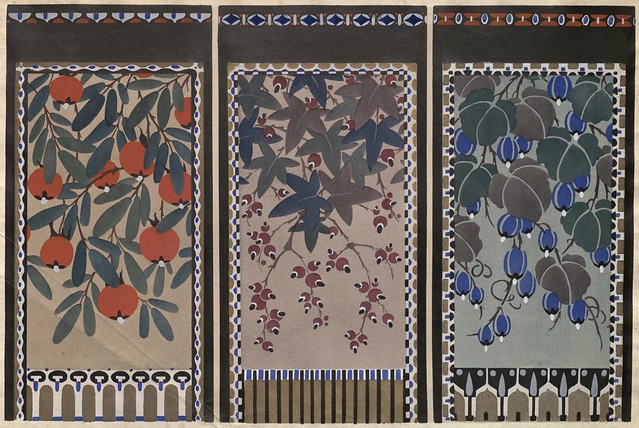
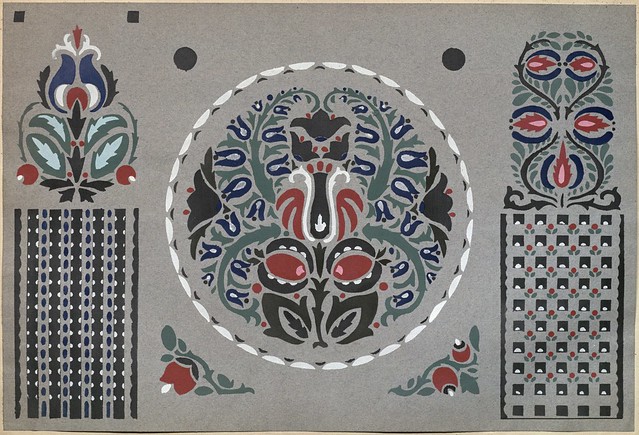
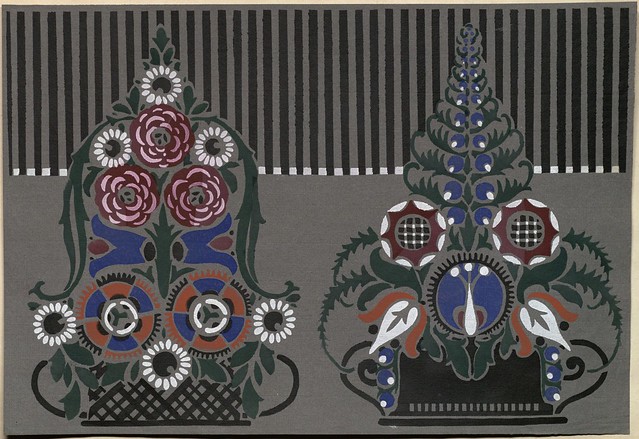
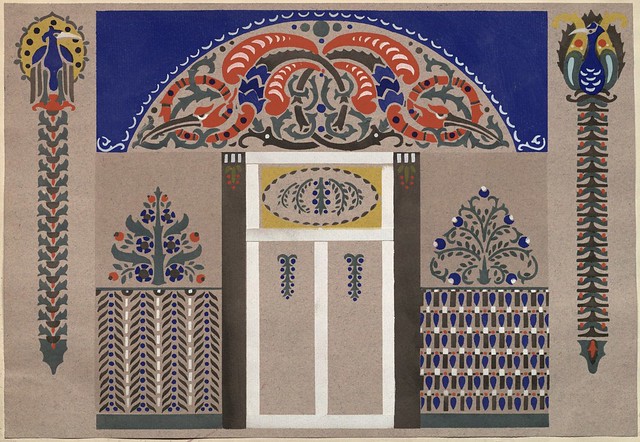
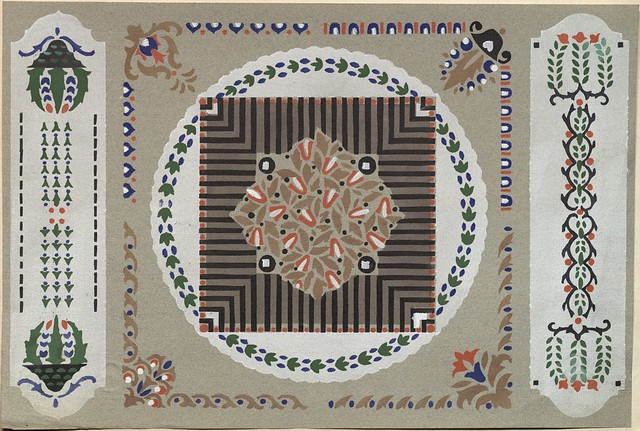

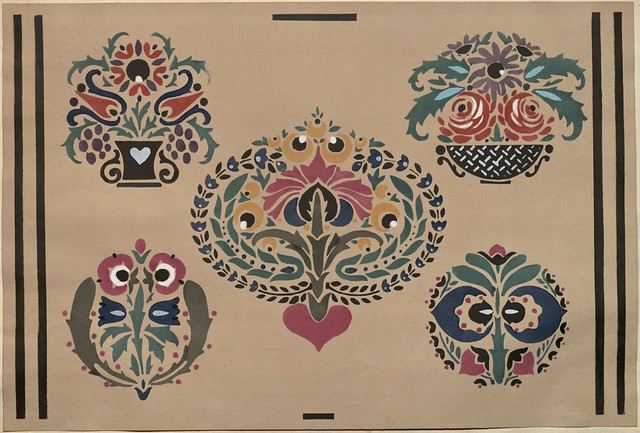
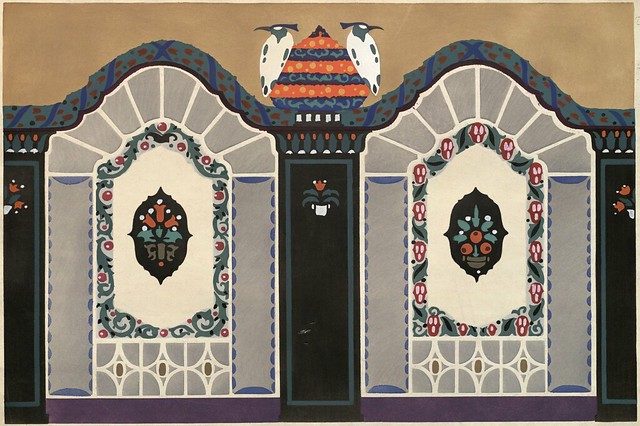
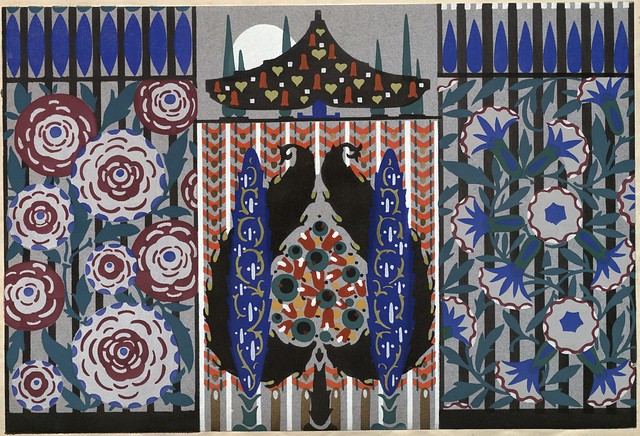
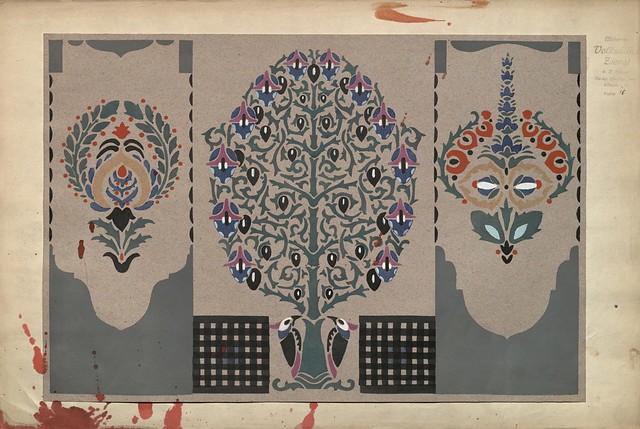
[This uncropped/untouched image shows the normal page layout;
the other images have been very lightly background cleaned]
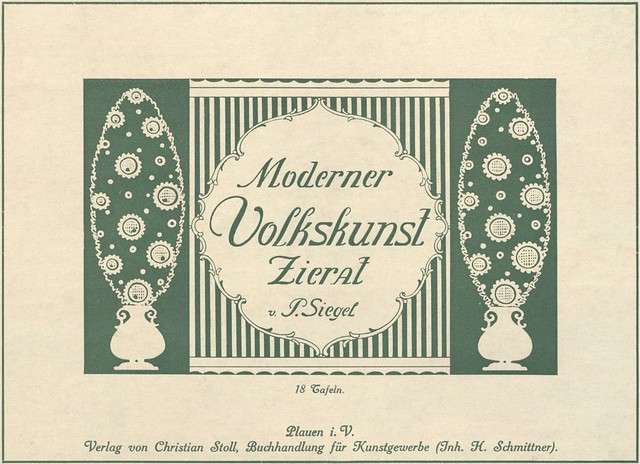
'Moderner Volkskunst Zierat' (Modern Folk Art Ornament) by P. Siegel (n.d.) is hosted online by the University of Houston Digital Library.
This album presents ornament design templates for use in decorating textiles, ceramics, wallpaper and related household items. They are fairly sophisticated patterns for folk art. The book of eighteen illustration plates was produced in Germany in the early decades of the 20th century, although the actual date of publication is unknown.
The scant mentions of this book online offer up release dates ranging from 1910 to 1930. I would guess 1920: the organic motifs are Art Nouveau in style, but the overall symmetry and order in the designs hint at the emergence of an Art Deco aesthetic. Or so I tell myself^; I'm often in two minds about specific eras and artistic styles (is it Baroque or Mannerist?; Renaissance or Early Modern? etc etc.). I think the fence is the right place to be on this occasion.
Later, I asked a web mate for his more professional opinion. He pegs the album to about 1910 and concludes it belongs to an artistic style that evolved in parallel with the Art Deco and Art Nouveau elements. It's the modernising of regional folk art into a stylised publishing form - with influence from Neoclassicism - that most associates 'Moderner Volkskunst Zierat' with a reform movement, and particularly the Vienna Secession^, in my mate's opinion. (this is a very brief summary of his reply and I hope I've got the gist of it correct)
Obviously this gets into the academic - and maybe pedantic - weeds of art history; whereas I was simply attracted to this set by the bold, colourful designs and interesting print style. The Saxony publishing firm of Christian Stoll issued quite a number of books in the first three decades (at least) of the 20th century on contemporary decorative arts.
- Pochoir: Vibrant Visions intro ~ & ~ The Art of the Pochoir Book.
- Wikipedia: Art Nouveau -- Art Deco -- Pochoir.
- Previously: Kiowa Pochoir Prints ::: Deco Vignettes ::: Design Nouveau ::: Pochoir Insects ::: Severini Pochoir ::: Pochoir.
- Andreas Closer Antiquariat lists 'Moderner Volkskunst Zierat' for €1200.
- Christian Stoll Publisher books: Internet Archive, Worldcat, Amazon