Baburnamah : a 16th c. autobiographical, illuminated, Persian / Islamic manuscript (copy), courtesy of the Walters Art Museum in Baltimore.
The manuscript miniatures below are cropped: please click through to the full-sized, full-page images hosted in Walters' Flickr set.

The Fall of Samarkand

The battle of Sultan Ḥusayn Mīrzā against
Sultan Masʿūd Mīrzā at Hiṣṣār in the winter of 1495
Sultan Masʿūd Mīrzā at Hiṣṣār in the winter of 1495

The siege and battle of Isfarah

Ḥamzah Sulṭān, Mahdī Sulṭan and Mamāq Sulṭān pay homage to Babur

Foray to Kuhat (Kohat)

Date Trees of Hindustan

Babur, during his second Hindustan campaign, riding a raft from Kunar back to Atar

The battle of Panipat and the death of Sultan Ibrāhīm, the last of the Lōdī Sultans of Delhi

Babur entering Kabul
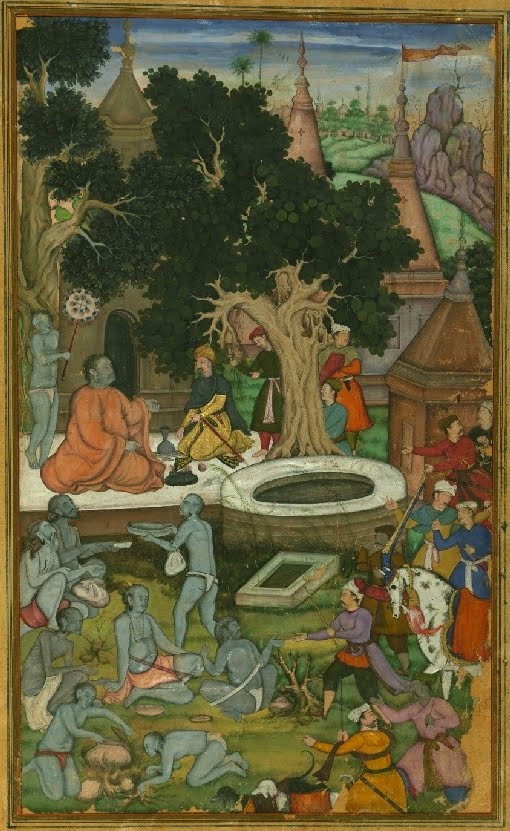
Babur and his warriors visit the Hindu temple Gurh Kattri (Kūr Katrī) in Bigram

Babur and his party hunting for rhinoceros in Swati

Animals of Hindustan: monkeys, rodents and a peacock
"Recognized as one of the world’s great autobiographical memoirs, the Baburnamah is the story of Zahir al-Din Muhammad Babur (1483-1530), who conquered northern India and established the Mughal Empire (or Timurid-Mughal empire).
Born in Fergana (Central Asia), Babur was a patrilineal Timurid and matrilineal Chingizid. Babur wrote his memoir in Chaghatay Turkish, which he referred to as Turkic, and it was later translated into Persian and repeatedly copied and illustrated under his Mughal successors.
The present copy in Persian, written in Nasta'liq script, is a fragment of a dispersed manuscript that was executed in the 16th century." {very slightly edited: PK}
Walters manuscript W.596 (Memoirs of Babur or Baburnamah) is available from the Walters Art Museum website or from their Flickr set.
Follow along on Twitter: Walters Art Museum and Will Noel (Manuscript Curator). Thanks Will! [Also see Will's great blog, Parchment and Pixel, where he features items of interest from the Museum].
The Walters Art Museum's online collection of manuscripts and rare books includes one hundred and forty Islamic works; or see the list: The Digital Walters.
Previously: arabic || illuminated