Saturday, April 01, 2006




Friday, March 31, 2006
The Cyanotype Work of Anna Atkins


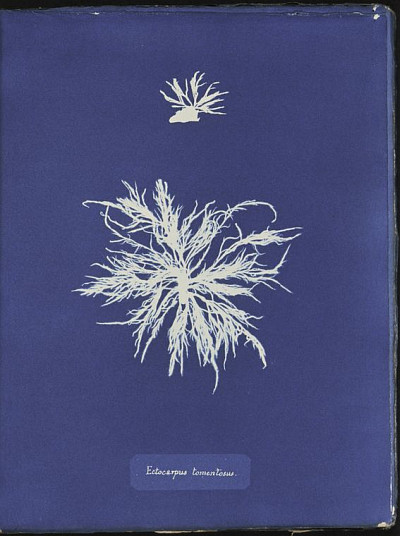
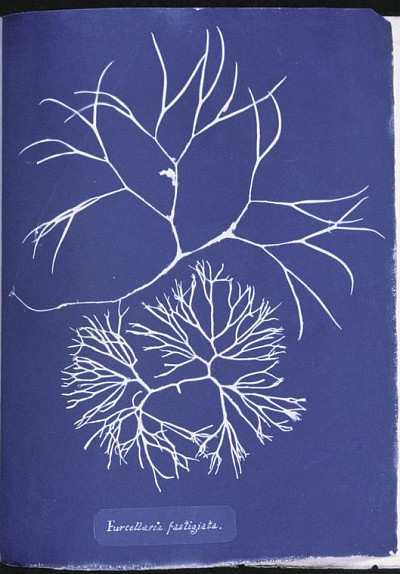


While it's technically true to categorize the cyanotype (blueprint or photogram) as a form of photography, it seems to straddle the fence with printmaking although this may just be semantics.
In 1841 or so, Sir John Herschel disovered the sensitivity to light of a particular iron solution. When this chemical is dissolved in water, it can be applied to a surface such as paper and an object is placed on top and during exposure to uv light, the background goes blue ('Prussian blue') and a negative image of the object remains. Simple and cheap and still practised today by artists and school children.
Anna Atkins had a solid education in science and was a member of the Botanical Society of London. She developed the Herschel discovery as a means of producing illustrations of the plants in which she was interested, chiefly algae and ferns.
"The difficulty of making accurate drawings of objects as minute as many of the Algae and Con[i]fera, has induced me to avail myself of Sir John Herschel's beautiful process of Cyanotype, to obtain impressions of the plants themselves."During the course of the 1840s Atkins produced more than 200 cyanotypes which were included in a 3 volume publication called Photographs of British Algae: Cyanotype Impressions. It stands as the first publication to include images made from a photographic technique and Atkins herself is distinguished as being the first ever female photographer. (The first photograph was produced by Joseph Nicephore Niépce in ~1827)
Thursday, March 30, 2006
Architectura Curiosa Nova Unplugged
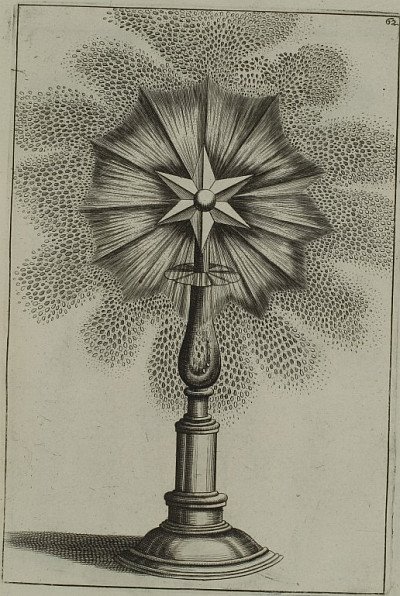
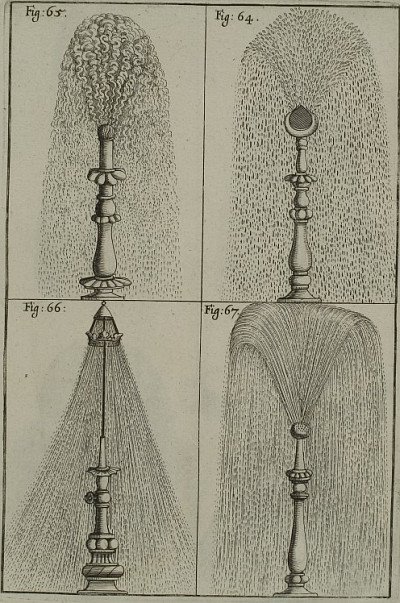

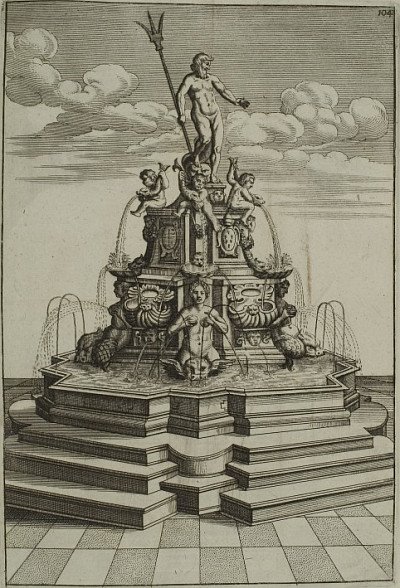


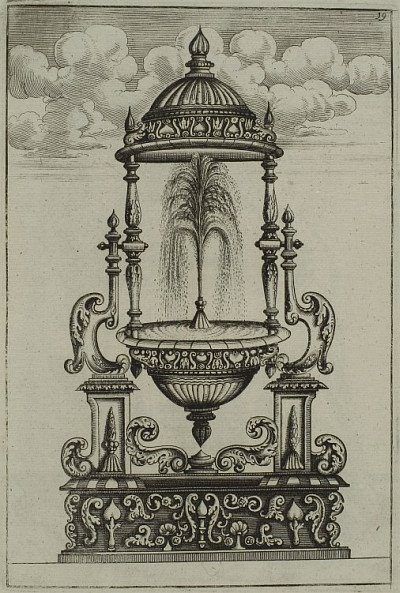

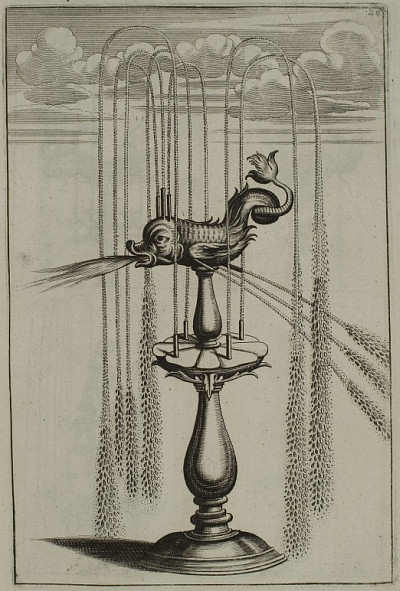

"Georg Andreas Böckler was a German architect, engineer and author. He was the architect of the city of Nuremberg and specialized in hydraulic architecture. Architectura Curiosa Nova was his main opus, a four-part work in one volume, published in 1664.
Illustrated with 200 engravings, the decorative plates of the first three parts show the theory and application of hydrodynamics for fountains, water-jets, spray-patterns, garden fountains and well heads; and elaborate and often fanciful designs for free-standing fountains. The fourth part includes designs for grottoes, garden pavilions and architectural designs including views of European palaces."
It was my good fortune while fossicking around in the digital cloisters of the University of Heidelburg to discover that since my last post about Böckler's Architectura Curiosa Nova, the whole work has been posted online. It would never be described as understated. Many wedding cake decoration ideas within.
The image above the engraving with the statue carrying a trident was the only plate I saw (when I remembered to look) with an engravers name, but I can't make it out even using the pdf zoom capability at the site.
Part I, II, III, IV of Architectura Curiosa Nova.nb. Part I of Architectura Curiosa Nova has quite a few pages of text and only a couple of images of piping diagrams; Part II has images of the fountain heads for the most part; Part III has both 'wall' variety and complete fountain images and Part IV concentrates on depicting some of the great houses of Europe and mazes.
- Previously: Böckler's other great work, Theatrum Machinarum Novum.
- Also previously: a post about another of the 'Theatre of Machines' authors, Jacques Besson, which has links to all the other renaissance engineering-type posts at BibliOdyssey.
- The best (large) colour examples from this baroque work can be found by searching on 'boeckler' at Panteek Gallery. [personally, I think the original black and white plates are superior]
- Mazarine have a 'quick and dirty' large thumbnail view of some of the mazes (a usual addition to any gardening or architectural landscape work of the day) from Part IV.
- For the keen: George Goodall's Facetation website is always worth perusing, even if it makes my head spin a bit [Böckler at Facetation]

Wednesday, March 29, 2006
Neither Rhyme Nor Reason
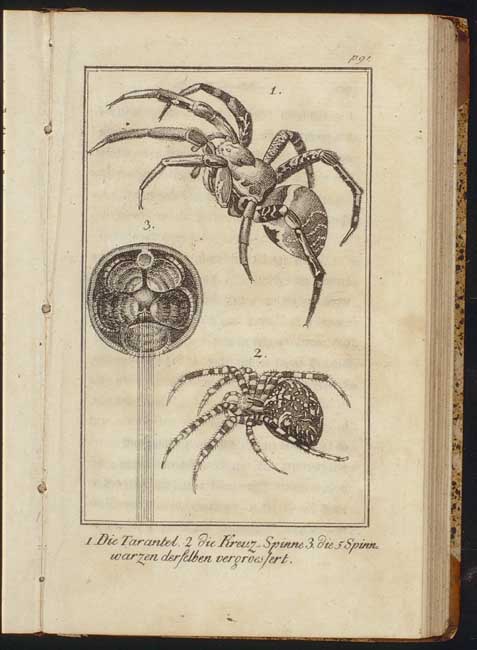 Tarantula
I thought I remembered where this came from but I was wrong.
 Travels of the Russian merchant Grigor'ii Shelikhov from 1783 to 1787 from Okhotsk over the Eastern Ocean to American shores, and his return to Russia, with detailed information on the opening of Kyktaka and Afagna - A frontpiece from somewhere in the Meeting of Frontiers collection at the Library of Congress.
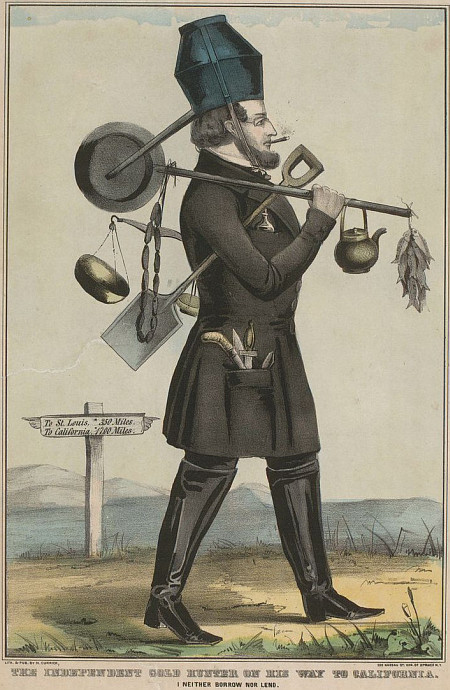 The Independent Gold Hunter on His Way to California.
 'I neither borrow nor lend'
c. 1849 - from the Online Archive of California.
 Tvende Slags Norske Söe-Orme 1752 Pontoppidan, Erik. I think this comes from Oslo University Library; they have a series on monster images and this was the only one I hadn't seen or previously posted.
 This is from an interesting set: Greetings received by the National Post Office in Norway from international postal organisations in the late 19th century; in this case from Japan. [thumbnail page]
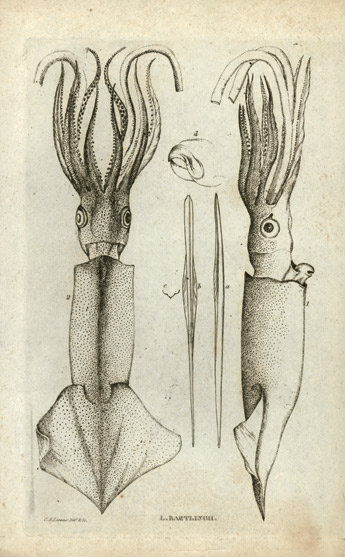 No recollection.
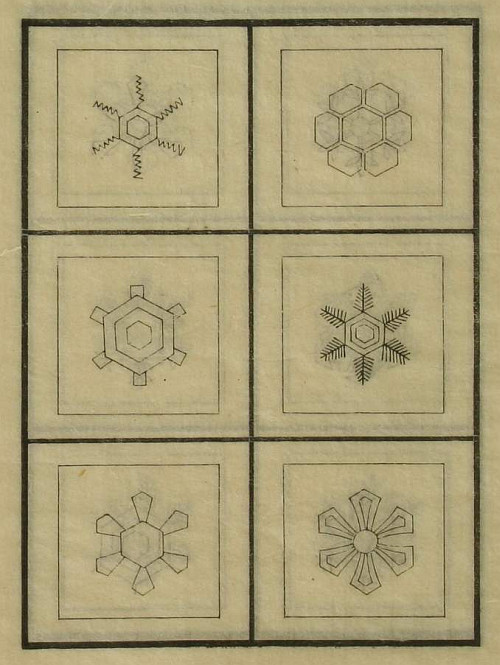 This is one of about 90 illustrations of snow crystals from the early 19th century in 3 volumes at Waseda University Library, Japan. Somewhere around there is an english description, alas I can't refind it at present. Those of you in the northern hemisphere may not wish to know anyway.
 Octonaries upon the Vanitie and Inconstancie of the World created in 1609 by Esther Inglis - a very short handcrafted manuscript at NYPL.
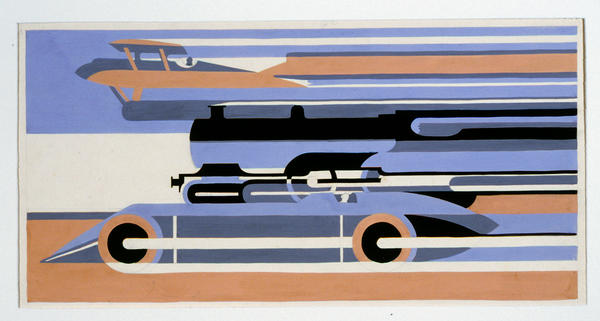 Aeroplane Train Car 1930's - one of more than 200 prints on display in the AE Haliwell collection at the University Arts and Humanities Data Service, UK.
 No recollection.
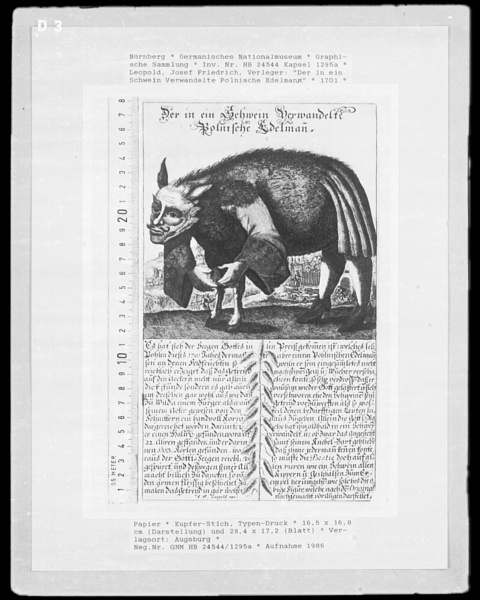 Leopold, Josef Friedrich, Der in ein Schwein Verwandelte Polnische Edelmann, 1701, Flugblatt, Nürnberg, Germanisches Nationalmuseum, Graphische Sammlung, HB 24544.
 No recollection.
Just uncluttering the desktop. Click images for larger versions.
Monday, March 27, 2006
The History of Colour Systems
"The law of proportion according to which the several colours are formed,
even if a man knew he would be foolish in telling, for he could not give any
necessary reason, nor indeed any tolerable or probable explanation of them."
Plato Timaeus
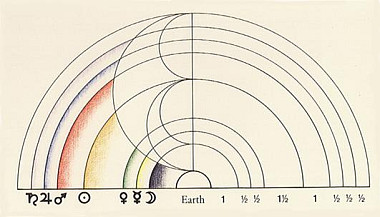 Pythagoras ~550BC
 Aristotle ~350BC
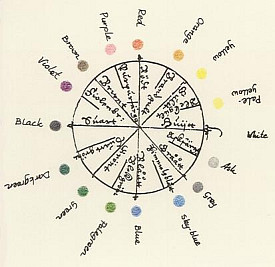 Aron Sigfrid Forsius 1611
 Athanasius Kircher 1646
 Sir Isaac Newton 1704
 Ignaz Schiffermüller 1772
 Tobias Mayer 1775
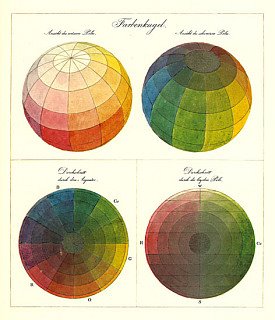 Philipp Otto Runge 1810
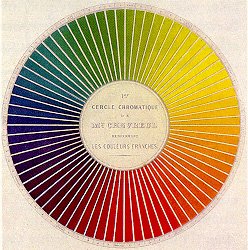 Michel Eugène Chevreul 1839
 Albert Henry Munsell 1915
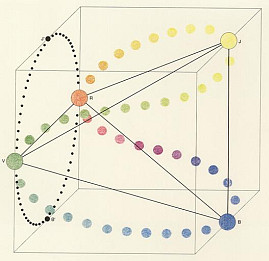 Michel Albert-Vanel 1983
When doing a physics course once, we were allowed to basically dismiss one of the subject components in relation to assessment. Reading around about colour systems reaffirms my original belief that optical physics is not really my strong suit. So on this occasion I think I'll refrain from crafting any sort of summary - it's very interesting stuff for sure but, well...I'm not so sure I've comprehended it all well.
The above illustrations come from The Colour Museum (in english, french and german) which gives a reasonably detailed overview of the history of the human conceptualization of colour. Many of their images are originals but it's a little hard to be sure at times. I suspect the contents of the site doesn't rise to the level of 'scholarship' but it is actually pretty fascinating nonetheless.
The University of Mannheim have a modest selection of original book illustrations on this subject.
Wikipedia on color.
Addit: more from the (excellent) Blanketfort.